Why FHIR Uses JSON and How It Compares to Relational Models


FHIR (Fast Healthcare Interoperability Resources) has become the standard for healthcare data exchange, and one of the most notable choices it makes is using JSON (JavaScript Object Notation) as its primary data format. Let’s break down why JSON was chosen, its pros and cons compared to relational databases, and how each FHIR resource effectively acts like its own subject area data mart.
Why JSON?
JSON is a lightweight, text-based format that's easy for machines and humans to read and write. FHIR embraces JSON for several reasons:
Simplicity: JSON is less verbose than XML and more intuitive for developers.
Flexibility: Supports nested structures, making it ideal for representing complex, hierarchical healthcare data (like observations tied to encounters and patients).
Interoperability: JSON integrates seamlessly with RESTful APIs, the backbone of modern web communication, aligning with FHIR's goal of web-based data sharing.
Extensibility: Adding new fields or extensions doesn’t break existing data structures, allowing for rapid evolution.
JSON vs. Relational Models
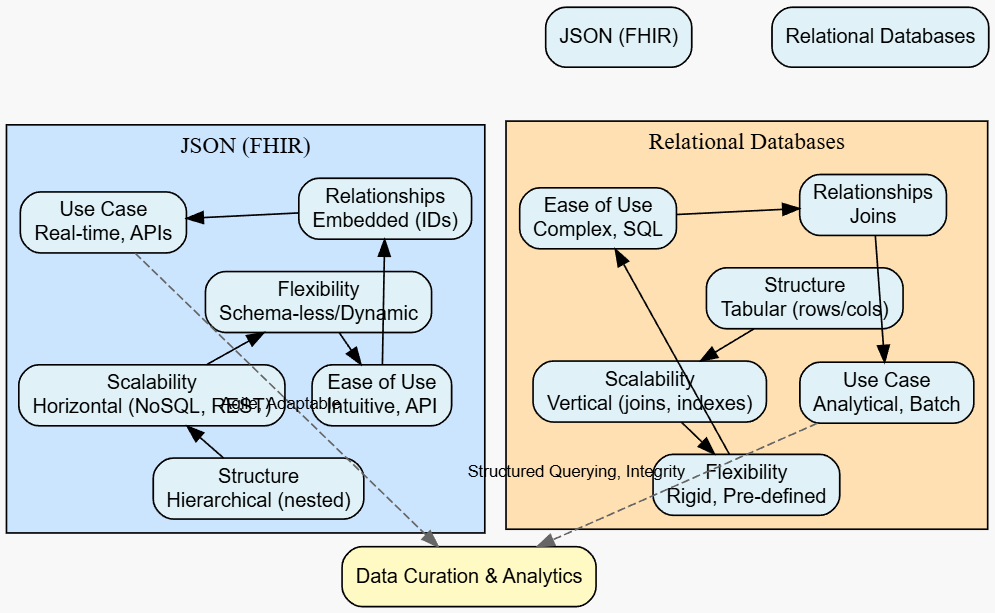
While JSON allows FHIR to be agile and adaptable, relational models still shine in data curation and analytics, where structured querying, aggregation, and integrity constraints are critical.
Discussion about this post