The (Slow) Burning Platform of Healthcare Tech
Promise of AI frameworks for Healthcare

Promises, Promises: Disruption Delayed in Medicine

For years, Silicon Valley has promised to do to healthcare what Uber did to taxis and Amazon did to retail. Yet a patient in 2025 still cannot summon medical care with the same ease as a taxi or track a prescription like a package delivery. Grand experiments have come and gone. Even Haven – the much-hyped joint venture of Amazon, JPMorgan, and Berkshire Hathaway – disbanded with little to show for its ambitions, a sobering reminder that even tech titans struggle to cure healthcare’s ailments (Fee-for-service - Wikipedia). The truth is that healthcare’s Byzantine economics and stakeholder maze have stymied swift “disruption.” Instead of one-click service and radical efficiency, we see a fragmented system clinging to fax machines and paper forms. The long-promised revolution seems, so far, more fancy PowerPoint than reality.
Why is healthcare so resistant to the sort of consumer-friendly upheaval seen elsewhere? A big part of the answer lies in misaligned incentives. Under the prevalent fee-for-service model, every test, scan, and visit pads the bill – rewarding quantity of care rather than quality. A clinic that finds a way to keep patients healthy (fewer visits, fewer procedures) paradoxically risks hurting its bottom line. Meanwhile, insurers – who would love to pay for outcomes, not activities – often still reimburse piecemeal. This clash has slowed the shift to value-based care, where providers are rewarded for keeping people well. Policymakers have tried nudging the system toward value; America’s Affordable Care Act even piloted accountable care organizations to realign incentives. But progress has been halting. As of the late 2010s, the majority of payments in the US healthcare system remained stubbornly fee-for-service, with only gradual uptake of value-based arrangements. In short, the economic glue that binds healthcare together often encourages doing more rather than doing better – hardly fertile soil for an Uber-esque innovator who promises to streamline care.
A Dysfunctional Love Triangle (Plus One)
Healthcare isn’t a simple two-party transaction like hailing a ride; it’s a multi-sided affair. Patients, providers (doctors, hospitals), and payers (insurance companies, government programs) form a tangled triangle – with pharmaceutical firms often lurking at the periphery. Communication and trust between these parties are notoriously fraught. Patients frequently feel like outsiders looking in, overwhelmed by medical jargon and bills. Providers complain they spend more time clicking drop-down menus and haggling with insurers than treating patients. Payers, for their part, foot the bills but often lack direct relationships with the people whose care they finance. And pharma? They develop lifesaving drugs, but their profit motives (and aggressive marketing) can sow suspicion.
Misalignment everywhere: The patient-provider-payer triad suffers from fundamental disconnects. Providers want to deliver good care, but under fee-for-service they get paid more when they deliver more care, not necessarily better care. Payers want to control costs and improve outcomes, but they rely on providers to actually do the work and on patients to adhere to plans. Patients ostensibly want to be healthy at minimal cost, yet the system bombards them with opaque pricing, surprise bills, and instructions they may not understand or follow. The result is that each player often acts in isolation or at cross purposes. It’s a bit like a stool with three legs, each leg a different length – a wobbly foundation for any grand tech-enabled transformation.
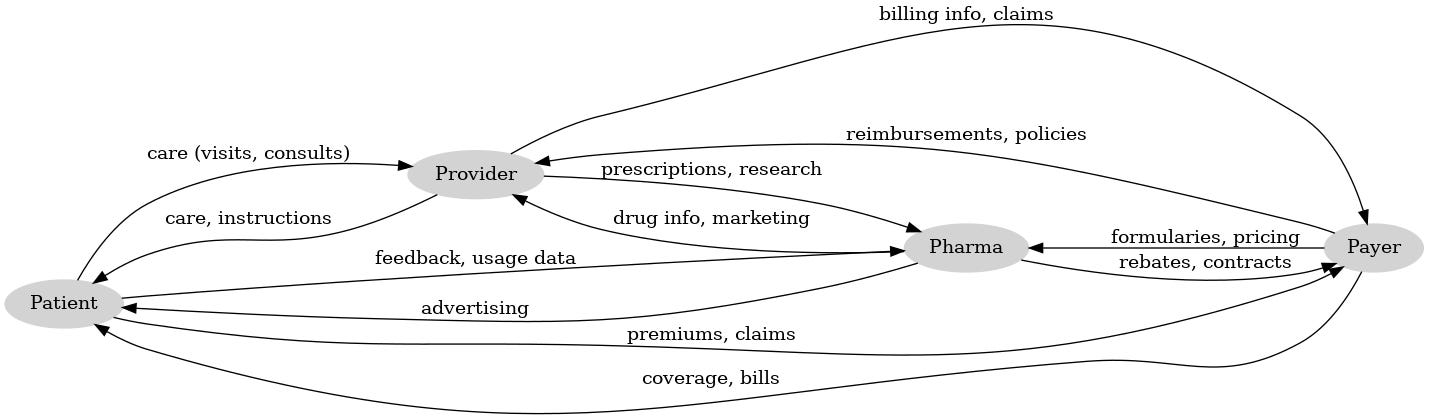
Healthcare’s key stakeholders – patients, providers, payers, and pharma – have complex, often fragmented relationships. Each arrow represents flows of care, information, or payments between actors (for example, providers send bills to payers, who reimburse providers; pharma supplies drugs to providers, who prescribe them to patients; insurers negotiate prices with pharma for drug coverage). Misaligned incentives and communication gaps across this web of interactions hinder seamless healthcare experiences.
Consider a typical chronicle of frustration: a patient tries to schedule a specialist appointment. They must navigate a tangle of referrals and insurance approvals (patient ↔ provider ↔ payer), only to wait weeks for an opening. Once in the exam room, the doctor might not have the full story – perhaps the lab results from another clinic never arrived, or the patient’s wearable device data isn’t even considered. After the visit, the patient leaves uncertain about next steps, the provider’s instructions battle the patient’s forgetfulness, and the insurer might later send an indecipherable bill. It’s a far cry from the integrated, user-friendly journey one experiences when, say, booking a vacation online. In healthcare, friction is the norm, not the exception.
Providers and patients do try to bridge the gaps – patient portals, telehealth chats, and disease management apps abound – but often these feel like patchwork on a leaky boat. A portal might let you message your doctor, yet many physicians aren’t reimbursed for time answering emails, so messages may languish. An insurer’s wellness app might urge you to get a flu shot, but your doctor’s office might be unaware you got it at the pharmacy. The left hand often doesn’t know what the right is doing. And without a shared language or platform, each new digital tool lives in its own silo, further fragmenting the experience.
The upshot: healthcare has remained an opaque, balkanized ecosystem, seemingly immune to the seamless integration that digital technology brought to other industries. Any remedy must confront these root causes – the misaligned incentives and communication barriers between patient, provider, payer (and yes, pharma too). Enter an unlikely duo of heroes: an esoteric data standard and a dash of artificial intelligence.
Interoperability: A New Hope in a Standard
If misaligned incentives are the hidden rot, lack of interoperability is the visible rust of healthcare. Medical data has historically been locked in proprietary vaults – each hospital or insurer guarding its own records like a dragon hoarding gold. Different computer systems didn’t speak to each other; at best, they exchanged awkward HL7 messages (the data equivalent of broken pidgin). The result: a patient’s allergy list or MRI scan often stays marooned in one provider’s database, useless to others who might need it. It’s as if every bank issued its own ATM card that only worked at its own ATMs – a world with no Cirrus or Visa network to connect them.
This is where the unglamorous but crucial FHIR standard enters the story. FHIR (pronounced “fire”) stands for Fast Healthcare Interoperability Resources, and it is exactly what its name implies: a common language for health data, designed for speed and compatibility on the modern web. Rather than bespoke interfaces and centuries-old file formats, FHIR uses the tools of the internet age – HTTP, JSON, OAuth – to make sharing health information as straightforward as sharing any other data online. Think of FHIR as healthcare’s equivalent of USB or Bluetooth: a standard plug that fits every system, enabling previously isolated devices to connect. With FHIR, an app made by a scrappy startup can, in theory, plug into Epic or Cerner (the giants of hospital electronic records) and trade data in real-time. Doctors, patients, and insurers can finally reference the same data, without expensive one-off integrations.
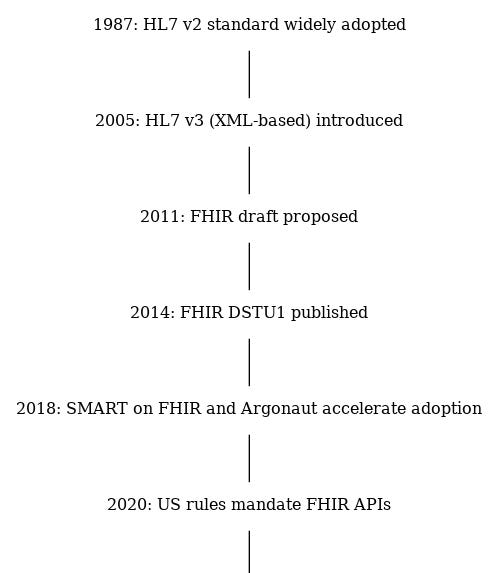
Major milestones in the evolution of health data standards. Beginning with HL7 v2 in the late 1980s, healthcare data exchange slowly progressed through iterations (the ill-fated HL7 v3 in the 2000s) before the introduction of FHIR in 2014. Subsequent years saw industry and government initiatives (SMART on FHIR, Argonaut) to drive adoption. By 2020, US regulations mandated FHIR-based APIs for payers and health systems, laying the groundwork for the next era: contextual AI that can leverage these interoperable data pipelines.
FHIR’s design reflects hard-earned lessons. HL7 v2 (circa 1987) was a workhorse messaging format, but each implementation tended to be unique – hospitals spent fortunes on interface engineers to get systems talking. HL7 v3 in the 2000s aimed for rigor with an ambitious XML-based model, but it collapsed under its own complexity. FHIR, born in the 2010s, took a different tack. It focuses on “resources” – modular pieces of health data (a Patient, an Observation, a Medication, etc.) – that can be individually retrieved and updated via standard web APIs. In plain English, instead of exchanging giant documents or inscrutable text strings, systems can now fetch just “the allergy list for patient Jane Doe” or “the lab result for test X,” using a URL call that any developer can understand (theoretically easier but harder in practice). By using modern web standards and a RESTful approach, FHIR dramatically lowers the technical barriers to entry. A med school dropout with some coding chops can write a new health app that pulls data from an EHR, in a weekend, using FHIR – something that was virtually impossible in the old days of closed systems.
Crucially, FHIR isn’t just a techie spec in an ivory tower; it’s being implemented. The past decade has seen a sea change in attitudes toward data sharing. Large EHR vendors and health systems, once reluctant, have been nudged (or shoved) into opening up. A coalition called the Argonaut Project in 2014 brought together Harvard researchers and industry players to accelerate FHIR’s real-world use. Soon after, major Monopoly vendors like Epic and Cerner – which together power a majority of US hospitals – began offering FHIR interfaces in their products. An alliance of health IT firms known as CommonWell Health Alliance jumped on board, as did an NIH-backed initiative called SMART on FHIR that provided a standardized way to build plug-and-play apps for EHRs.
The federal government applied further pressure (wielding both carrot and stick). In 2020, the U.S. Centers for Medicare & Medicaid Services (CMS) issued landmark rules under the 21st Century Cures Act: hospitals and insurers must make patient data available through FHIR-based APIs. Want to continue participating in Medicare? Better have an API that lets patients download their records or share them with an app of their choice. This mandate was a game-changer – overnight, even the laggards had to implement FHIR or face penalties. By 2021, a flood of health data previously trapped in siloed systems was starting to flow through secure endpoints that any authorized application could query. The stage was set for an ecosystem of interoperable healthtech, finally enabling the kind of innovation seen in more open industries like finance (imagine if Mint.com or PayPal had never been allowed to connect to your bank – that was healthcare pre-FHIR).
Perhaps the most tangible sign of progress came from an unlikely suspect: Apple. In early 2018, Apple’s Health app introduced a feature for users to fetch their medical records from participating hospitals and clinics. How did they do it? FHIR. Apple essentially acted as a front-end for FHIR APIs that health systems exposed, allowing iPhone owners to pull in lab results, immunizations, medications, and more, right into their pocket. Suddenly, tens of millions of patients had a taste of what true data portability feels like – and they liked it. No more CDs of MRI images or paper printouts of bloodwork; it could all flow into one place under the patient’s control. Today, hundreds of institutions (including heavyweights like Johns Hopkins and the Mayo Clinic) sync data to patients’ phones through this standard.
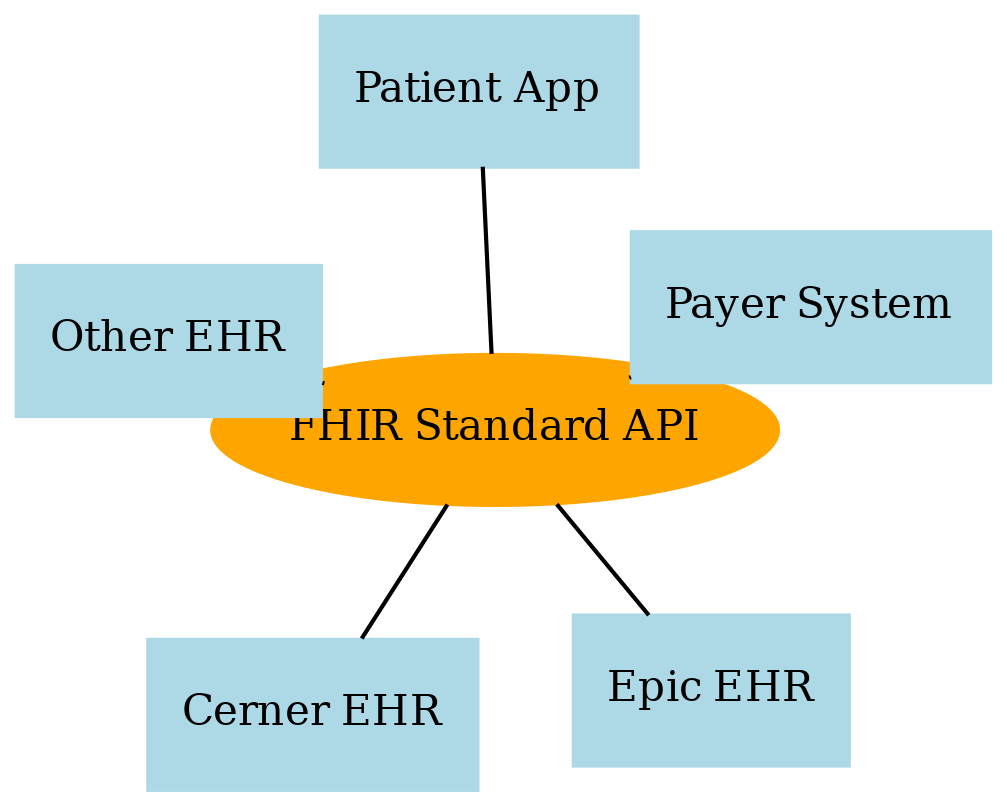
A simplified view of interoperability: multiple healthcare systems (from EHRs like Epic and Cerner to insurance databases and patient-facing apps) can communicate through a common FHIR-based API layer. This standard interface allows data to flow securely and seamlessly between previously siloed platforms. In practice, this means a patient’s smartphone app, a hospital’s medical record system, and an insurer’s database can all “speak FHIR,” exchanging information in real time.
Interoperability, long a policy buzzword, is finally becoming reality. Just as ATMs in the 1980s networked banks together so your debit card worked anywhere, FHIR in the 2020s is networking healthcare entities so your medical information can travel with you. And like standardized charging cables enabling any phone to plug into any outlet, FHIR is the universal connector that turns disparate health IT systems into one big, if messy, network. This transformation is foundational – it doesn’t automatically solve the deeper incentive problems, but it does create the conditions where innovative solutions can actually take root.
Context Is King: The Rise of AI Agents in Healthcare
With troves of standardized data now potentially at their fingertips, artificial intelligence systems have a richer playground to operate in. Over the past couple of years, a new breed of AI – large language models and their kin – have demonstrated astonishing abilities to interpret text, images, even biomedical literature. These models, like GPT-4o and Med-PaLM2, can answer medical questions, draft clinical notes, and suggest diagnoses from symptoms. It’s not hard to imagine a near future where every patient and every clinician has a digital assistant whispering in their ear (or phone), providing tailored guidance. But to truly shine in healthcare, AI needs context – it needs to know the patient’s history, the current medications, the insurance constraints, the latest clinical guidelines. In isolation, even the smartest chatbot is just that: isolated.
Enter the concept of contextual AI ecosystems. This is where acronyms like MCP (Model Context Protocol) and A2A (Agent-to-Agent) come into play. While they may sound like technobabble, they herald an important evolution: moving from single, siloed AI agents to a network of AI agents that can talk to each other and integrate real-world data. Think of an army of specialized bots: one knows all about scheduling appointments, another is an expert in drug interactions, another tracks patient-reported symptoms, and yet another handles insurance authorizations. On their own, each might be useful. But when orchestrated together – sharing context with each other and with traditional IT systems via standard protocols – they become incredibly powerful. The whole truly becomes greater than the sum of its parts.
MCP, or Model Context Protocol, is essentially a proposed standard for how these AI models share information about their context and state. If FHIR is a common language for health data, MCP would be a common language for AI agents to discuss what they’re working on. It ensures that a patient’s relevant data (from FHIR APIs) plus situational context (e.g. “patient is contacting support about a billing issue” or “patient’s blood pressure monitor just sent an alert”) can be packaged and fed into the reasoning process of one or multiple AI models. Instead of each agent operating in a vacuum, they have a shared situational awareness. In practical terms, MCP could allow a consumer health app’s AI to say to a hospital’s AI: “Here is Mrs. Smith’s current context: she’s a 68-year-old with diabetes and hypertension, her last glucose readings have been high, and she is asking about a foot ulcer.” The hospital’s AI, which might be more powerful or have access to scheduling and her doctor’s availability, can then act on that context – for instance, by scheduling an earlier appointment or flagging a message to the doctor.
Meanwhile, Agent-to-Agent (A2A) communication, as the name suggests, allows one AI agent to delegate tasks to another. Google and others have been experimenting with this idea that complex problems can be solved by a team of AIs working in concert, each handling a piece. In healthcare, A2A could look like this: a “navigator” agent helps a patient figure out what kind of care they need, then hands off to a “scheduler” agent to actually book it, which in turn might consult a “insurance bot” to verify coverage. These agents might live in different organizations (one at the clinic, one at the insurance company) but if they all speak a common protocol and have secure channels, they can negotiate and cooperate behind the scenes. A2A essentially treats each AI like a microservice in a grand, distributed healthcare AI system.
It’s early days for these concepts, but the momentum is there. Just as importantly, the newly unlocked FHIR data pipelines provide the fuel for these AI engines. An AI can’t effectively remind you to take your medication if it doesn’t know what meds you’re on – but with FHIR, it can fetch your medication list from your doctor’s system (with your permission). It can’t reschedule your cardiologist appointment if it has no access to the calendar – but with FHIR hooks and A2A, your personal health agent could talk to the hospital’s scheduling agent to find a slot next Tuesday at 10 AM and pencil you in, then update your calendar and send you a confirmation, all in a blink. In short, AI + Interoperability = Intelligence in action.
From Hype to Help: AI in the Wild

All this may sound abstract, but we’re already seeing sprouts of this AI-enabled future in the real world. Take something as mundane as appointment scheduling. Missed appointments and long wait times are costly and frustrating. Some health systems have begun deploying AI assistants to handle the back-and-forth of scheduling. Kaiser Permanente, for example, has experimented with an AI-driven system that reaches out to patients due for appointments, offering available slots via text/chat and even rebooking automatically if a patient cancels last-minute. Early pilots showed significant reductions in no-show rates and happier scheduling staff, who were freed from phone tag to focus on in-person patient needs. In another case, a New York-based hospital implemented a chatbot to help patients schedule COVID-19 vaccine appointments in 2021, handling millions of queries and bookings without human intervention – an A/B test in how AI could act as a 24/7 front desk receptionist. These are simple “single-agent” examples, but they prove the point: given access to the right data (appointment slots, patient contact info, eligibility criteria), an AI can streamline scheduling at scale.
Consider care navigation and triage – historically the role of primary care gatekeepers and advice nurses. Here, AI has already made controversial waves. Babylon Health, a UK-based startup, deployed an AI symptom-checker that purported to handle routine triage for NHS patients via a chat interface. Users would input symptoms and get advice on whether they likely had a self-treatable ailment, needed a GP visit, or should head to A&E (ER). While Babylon’s claims of AI diagnostic prowess were hotly debated, the fact is thousands of patients began their care journey talking to a bot instead of a human. The system could safely handle many routine cases, referring only the more complex ones to professionals. Other symptom checkers (Ada, Buoy, WebMD’s chatbot) have similarly served as digital “first contact” for care. Now imagine tying these chatbots into the patient’s actual medical record and insurance info: the bot wouldn’t just say “It looks like you may have X, see a doctor”; it could directly schedule that doctor (knowing who’s in-network for you) and upload the conversation transcript to the clinic’s system so the doctor knows what’s up before you arrive.
Preventive care and chronic disease management are perhaps the biggest prizes. That’s where healthcare really moves the needle – keeping people healthy, avoiding hospitalizations. AI models excel at pattern recognition and prediction, making them well-suited to sift through data and flag risks. Hospitals are beginning to use AI to predict which patients are likely to be readmitted after discharge, or which diabetics might have a crisis in the next 3 months. But historically those predictions often died on the vine; the care team had no efficient way to act on them for dozens or hundreds of patients. Today, we’re inching toward systems where an AI can not only predict but also coordinate an intervention. For instance, an integrated health system might have an AI that monitors all hypertensive patients’ blood pressure readings (coming in via Bluetooth cuffs at home). If it spots trends of concern, it can automatically alert a care manager and also ping the patient through an app: “Your recent readings have been high. We can help – would you like to schedule a quick telehealth consult to adjust your meds?” The patient clicks “Yes,” and the AI scheduler (our friend from earlier) books a telehealth slot for the next day. The doctor doing the telehealth visit sees on their screen an AI-generated summary: “Patient’s BP has averaged 150/95 for past 2 weeks, AI suggests possible medication non-adherence or insufficient dosing. Patient also due for kidney function lab test.” This saves the doctor time and focuses the encounter. After the visit, the AI follows up with the patient daily: “Did you take your new dose this morning?” – nudging as needed, and perhaps looping back to the doctor or a nurse if the situation doesn’t improve.
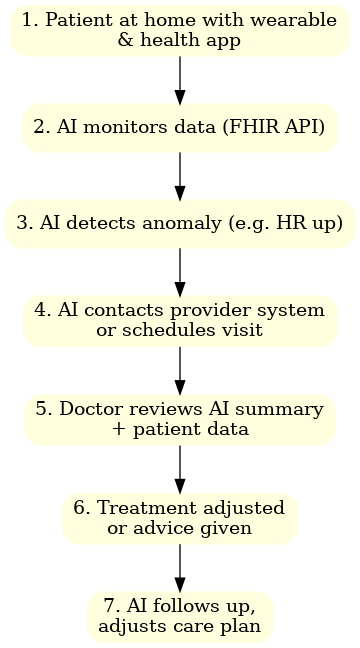
A hypothetical AI-assisted care journey: (1) A patient at home uses a wearable or health app that continuously monitors data. (2) That data flows through FHIR APIs to an AI system that watches for issues. (3) The AI detects an anomaly – say, an elevated heart rate or a concerning symptom report. (4) The AI agent contacts the provider’s system or directly schedules an appointment, as needed, possibly negotiating via an A2A protocol. (5) The doctor receives a concise AI-generated summary of the issue and relevant patient history before the visit. (6) The patient receives treatment or advice during a streamlined consultation, with AI assisting in documentation or decision support. (7) After the visit, the AI follows up with the patient (e.g. monitoring symptoms or adherence) and adjusts the care plan or alerts the provider if further action is needed. This closed-loop system illustrates how AI, fed by interoperable data, can create a continuous, proactive care experience instead of episodic, reactive care.
None of this requires sci-fi general intelligence – it requires plumbing, coordination, and lots of if-then rules augmented by machine learning. The pieces are finally coming together: ubiquitous sensors and apps generating data, FHIR pipes carrying that data, and AIs ready to analyze and act on it in real-time. The outcome could be a shift from reactive healthcare (we treat you after you crash) to proactive health management (we intervene early to prevent the crash).
Towards a “Supercomputer of the Mind”
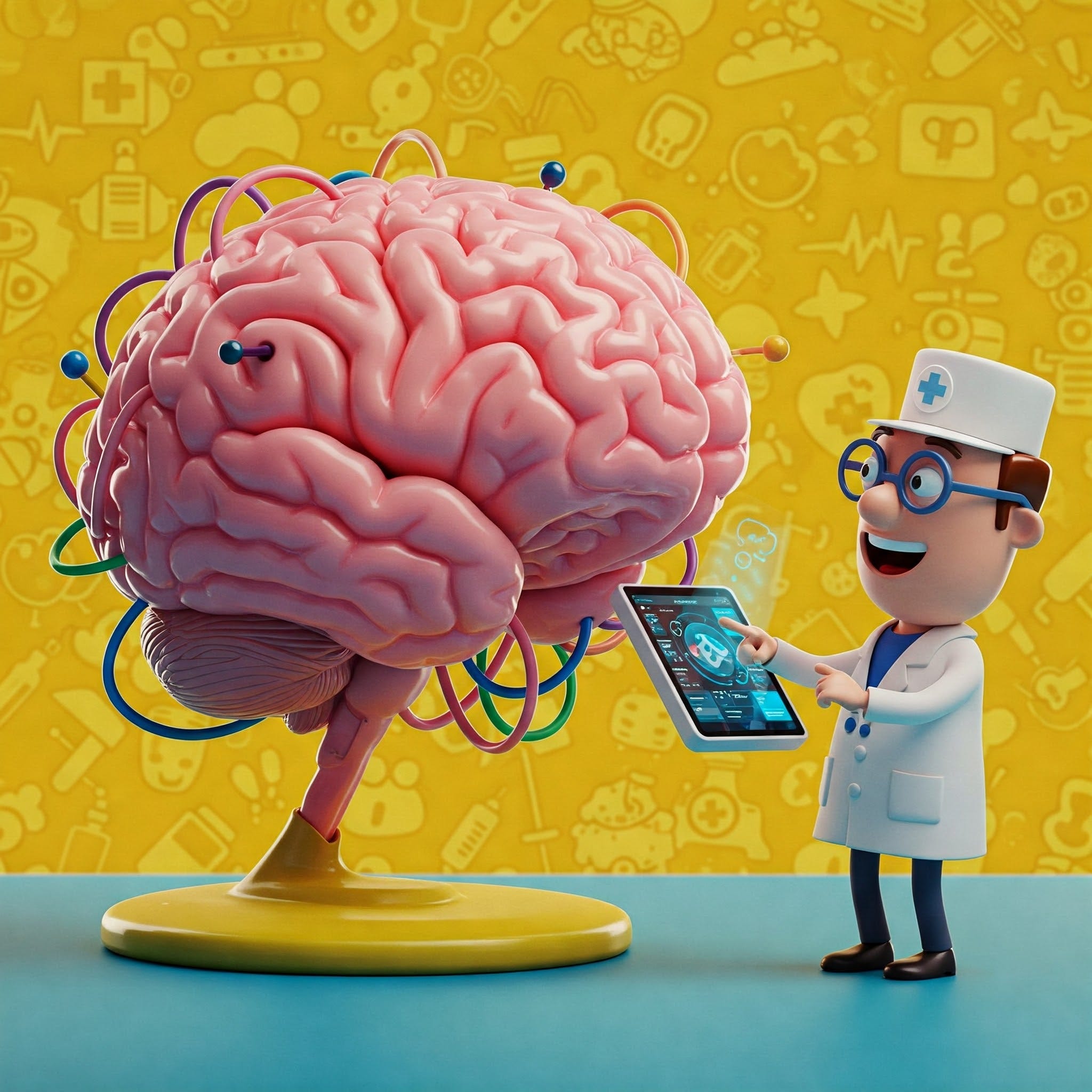
The endgame of these trends is an almost Star Trek-like vision of healthcare: each person partnered with an AI that knows them intimately and helps orchestrate all aspects of their well-being. Imagine it as a “Supercomputer of the Mind” – not replacing doctors and nurses, but augmenting every decision, guiding every step. This AI would integrate every node of the healthcare ecosystem on the patient’s behalf: primary care providers, specialists, pharmacies, labs, insurers, even fitness coaches and clinical researchers. It would be like having a personal medical concierge who never sleeps and is impossibly well-read.
What might a day in the life of someone using such an AI look like? Perhaps in the morning, your smart mirror notes a skin lesion that wasn’t there before. Your AI, always vigilant, analyzes the image (it’s been trained on millions of dermatology cases) and whispers that it’s likely benign – but just to be safe, it’s already scheduled a virtual dermatologist consult. On your drive to work, the AI chimes in through your car speakers (safely, of course) to remind you that you’ve been slightly inconsistent with your physical therapy exercises – it noticed via your smartwatch’s motion data. It encourages you to do a quick set when you arrive at the office (calendar adjusted accordingly). Near lunchtime, you receive a subtle prompt: based on your continuous glucose monitor, the AI suggests a higher-fiber option at lunch to keep your blood sugar steady (it even orders it for you with a tap, using your favorite food delivery app). In the afternoon, you get a message that your insurance approved the specialist referral your doctor put in yesterday – not that you had to lift a finger; the AI’s administrative twin handled the prior authorization in the background by exchanging data and forms with the payer’s system. The specialist already has your full updated record by the time you walk in, courtesy of – you guessed it – FHIR data exchange, so you don’t have to recount your entire saga from scratch. After your appointment, the AI summarizes the key points and updates your personal health journal, which you can review anytime (or even share with family if you choose).
This vision hinges on standardization and connectivity every step of the way. The AI can only be as good as the data it can access and the actions it’s authorized to perform. That means universality is key: every clinic, every pharmacy, every lab has to be reachable through common protocols. We’re not fully there yet, but the trajectory is set. Governments are doubling down on interoperability mandates, and even big tech companies (Microsoft, Google, Apple) now build health platforms around FHIR by default, not proprietary formats. There’s active work on the next layers too – standards for identity and consent management (so that your data moves when and where you want securely), and standards for workflow (so that an AI can, say, place an order in a doctor’s electronic system as an assistant would). The analogy can be made to the early days of the internet: before the 1990s, networks were fragmented; then TCP/IP, HTTP, and the web browser emerged, and suddenly a unified information space was born. Healthcare is in a similar transitional period. FHIR and related standards are its TCP/IP. Perhaps MCP could be its next-gen HTTP for AI interactions. And the role of the browser? Maybe your smartphone, serving as the window into this integrated health universe.
Skeptics will rightly point out that healthcare’s history is littered with failed promises and hyped silver bullets. Is our optimism today just another case of futurism fever? Possibly – caution is warranted. There are significant challenges ahead. Privacy concerns loom large: networking all this data and deploying AI everywhere raises the stakes for data breaches or misuse. Patients and providers will need to trust these systems, and trust is earned slowly. Regulators will have to adapt, defining new rules for AI accountability (who is liable if an AI makes a serious mistake in managing someone’s care?). And the human element can’t be ignored: healthcare is deeply personal, and empathy and human judgment remain irreplaceable. No one wants a dystopian scenario where chatbots deny surgery to cut costs or a glitchy algorithm triggers false health alarms at 3 a.m.
Yet, the direction is clear and largely positive. After decades of incremental steps, we are finally poised to break the stalemate that has kept healthcare in a pre-digital purgatory. Interoperability is turning data into a shared asset rather than a private prize. AI is turning that data into actionable wisdom, and doing so at scale and speed unattainable by human workforce alone. And incentives – slowly, but surely – are being realigned to reward keeping people healthy, which naturally dovetails with deploying these digital tools that prevent errors, waste, and missed opportunities for early care.
In a characteristically witty observation, The Economist once quipped that the only innovation in healthcare that consistently lowers cost is prevention. The fusion of FHIR-facilitated data exchange with AI-driven context and foresight might finally deliver prevention at scale – not just medical prevention of illness, but prevention of all the small failures (missed info, miscommunications, delays) that cumulatively degrade healthcare. It’s not the flashy “Uber for X” disruption we were promised a decade ago; it’s more profound. It’s a rewiring of the entire system’s nervous system. We may not notice a dramatic overnight change – revolutions in healthcare are often quiet and messy – but if one looks closely, the pixels of a new picture are coming together.
Someday in the not-too-distant future, we’ll look back and marvel that there was a time when a doctor’s knowledge of a patient was confined to what was in her own EHR, or when a patient had to act as the courier of their health information, or when an AI assistant couldn’t collaborate with another AI because their databases couldn’t talk. Those will seem like the days of steam engines before rail gauges were standardized – a quaint era of localized, isolated progress. The next era – the one we are venturing into now – promises something different: a truly connected healthcare ecosystem, where information and intelligence flow as freely as blood through veins, in service of keeping us all healthier. The “Supercomputer of the Mind” will not live in any one machine; it will be the emergent intelligence of an entire network working in concert – doctors, patients, AIs, data – all finally on the same page.
In the final analysis, the long-awaited “disruption” of healthcare might not arrive with a bang but with a series of interoperable whirs – the hum of countless APIs and AI agents quietly doing the work, transforming care from the inside out. And as that future unfolds, we may come to realize that the greatest revolution in healthcare was not a single killer app or gadget, but the decision to set the data free and let our collective ingenuity build atop it. In setting it free, we ignited a FHIR that could very well light the way to healthcare’s promised land.
Sources: The ideas in this article draw on healthcare interoperability standards documentation (Fast Healthcare Interoperability Resources - Wikipedia), industry case studies of FHIR adoption , federal healthcare policy mandates , analyses of fee-for-service vs value-based care incentives (Fee-for-service - Wikipedia), and emerging research on AI agent collaboration (MCP, A2A). These converging trends illustrate a hopeful path forward at the intersection of technology and health.
This post was created with assistance of AI
Discussion about this post