The Provider Directory Lie
I audited 27.2 million records in the CMS National Provider Directory. The data is worse than the industry has admitted, and CMS just asked every state Medicaid agency to revalidate against it.

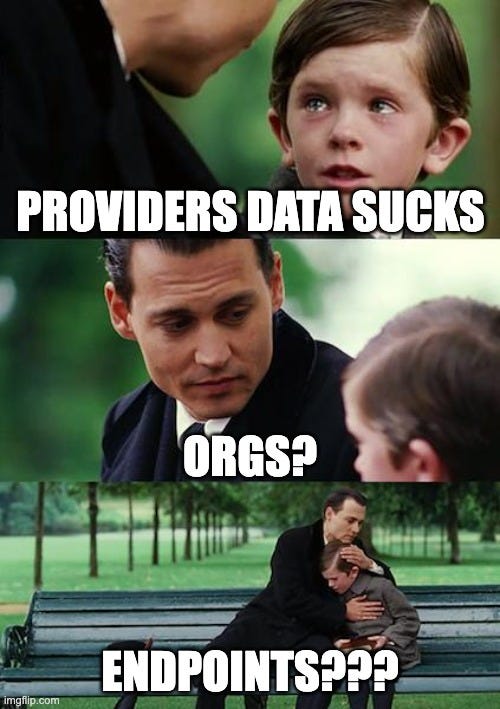
Last week I posted on LinkedIn that provider directory was the longest-running unsolved problem in healthcare data and that the industry had mostly coped by pretending it was solved. The post moved: 8,622 impressions, 5,714 members reached, 79 reactions, 21 comments, 22 followers gained from a single post. The replies clustered into two camps.
The “we have NDH now” replies are why I spent the last week auditing every byte of the public CMS National Provider Directory bulk export.
27.2 million resources. Six FHIR resource types. Cross-referenced against the NPPES monthly dissemination file, the current NUCC quarterly taxonomy, and the CMS Medicare specialty crosswalk. Live HTTP probes against every distinct FHIR-REST host declared inside the directory.
The audit is published at ainpi.dev. The methodology and code are on GitHub under Apache 2.0. Every null hypothesis, denominator, and threshold was registered before the numbers were computed. That is the entire point. If the data is bad, you do not get to find that out from the same vendors who built the data.
Here is what I found.
The audit, in five numbers
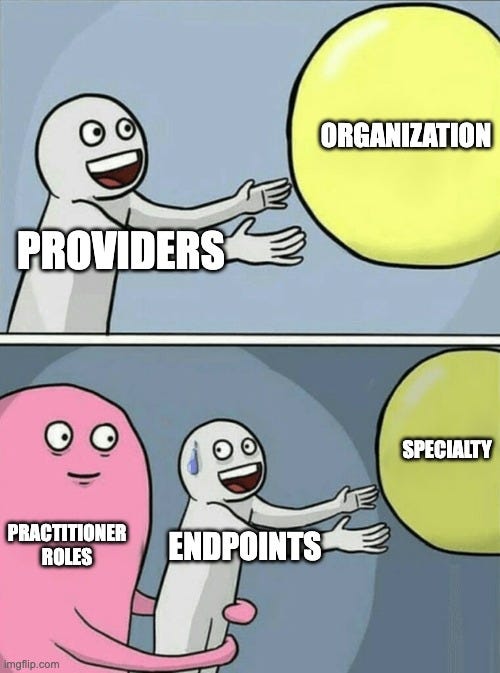
70.5%. Of the 1,999,118 unique Organization NPIs in the NDH bulk export, 70.5% map to more than one Organization resource. Normalized by name, state, and city, 70.3% of keys repeat. One NPI maps to as many as five resources. Any downstream consumer that assumes one Organization resource equals one real-world organization will be wrong roughly two times out of three. Counts are inflated by about 1.7x at the entity level.
97%. Of the 5,043,524 Endpoint resources in the NDH, only 2.96% carry a managingOrganization reference back to an Organization. You cannot traverse from “here is a FHIR endpoint” to “here is the organization that owns it” using the directory itself. The link the spec provides for that join is unpopulated 97 times out of 100. The reverse is also true: 98.7% of Organizations have zero Endpoint references at all.
4 of 10. The NDH Implementation Guide defines ten resources. The April 9, 2026 NPD bulk export ships six. HealthcareService, InsurancePlan, Network, and Verification are absent. Any rule, audit, or product feature that depends on those four resources cannot be built from the public NDH artifact. They simply are not there.
18.4%. Of the 2,974 distinct FHIR-REST hosts the NDH declares, 18.4% lack a valid SMART well-known discovery document. 14.6% return no parseable CapabilityStatement at /metadata. The technical reachability floor sits below the 85% network-adequacy threshold implied by 42 CFR §422.116 the moment the bar moves from “answers HTTP” to “is conformant enough for an app to actually use.” 271 TLS certs were 90 days or fewer from expiry on probe day.
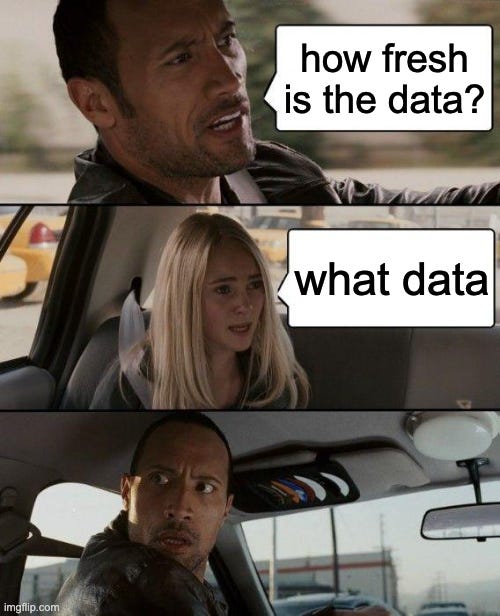
100% lastUpdated, 0% freshness. Every NDH resource carries a meta.lastUpdated value. There are exactly five distinct timestamps across all 27.2 million records. meta.lastUpdated on the bulk file is the export stamp. It is not a per-resource freshness signal. CMS-9115-F’s 30-day update rule and the No Surprises Act 90-day cadence cannot be measured from the file the federal government publishes for that purpose.
Those are the headlines. The footnotes are worse.
The footnotes are worse
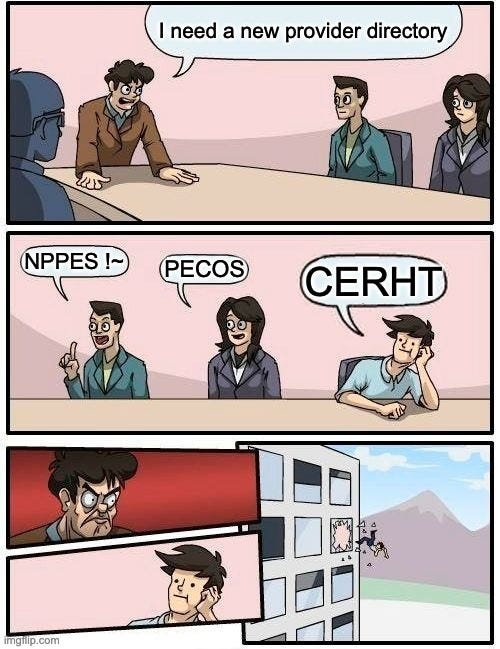
86,068 NPIs that exist in the NDH do not exist in NPPES at all. 379,510 are deactivated in NPPES but still live in the NDH. The agency that mints the identifier and the agency that publishes the directory are running eight weeks out of sync, and the gap shows up as ghost records and zombie records sitting in the file health plans, scheduling tools, and AI agents are now being told to trust.
The NDH ships taxonomy on two different resources using two different code systems. Practitioner specialty codes use NUCC. PractitionerRole specialty codes use the CMS Medicare crosswalk. Both are 99%+ structurally valid in isolation. They disagree with each other 14% of the time. Internal Medicine becomes Hospitalist, Diagnostic Radiology becomes Vascular and Interventional Radiology, Family Practice becomes Emergency Medicine. Pick whichever code system your filter happens to prefer and you will get a different answer to “what kind of doctor is this.”
Even the NPPES join most consumers run is wrong in a way nobody documents. NPPES stores up to 15 taxonomy slots per provider with a primary_switch flag. Almost every directory comparison I have ever seen treats slot 1 as the primary. 14.93% of NPPES records have the true primary, the one with switch='Y', in a slot other than slot 1. If you have built a taxonomy match against slot 1, you have a 15% systemic error that has never been on a slide deck.
Practitioner deduplication is clean. Zero excess rows across 7.4 million NPIs. The defect is concentrated in Organizations, which is exactly the resource type every payer matching pipeline, every TIN-to-NPI rollup, every network adequacy report, and every “find a doctor” search treats as a stable entity.
It is not a stable entity. It is a thicket.
What this costs, in dollars
Healthcare’s provider data problem is not a technical curiosity. It is the substrate underneath every quality measurement program, every claims adjudication system, every credentialing decision, every prior authorization, and every “find a provider in network” search a member ever runs.
I spent 5 years inside a large integrated delivery network. We had a dedicated provider data management team. They scrubbed continuously. The ceiling we hit was around 80% data quality, and that was for our own employed and contracted providers, on data we owned, with operational levers most health plans cannot pull. HEDIS denominators, Star ratings rollups, and risk adjustment all run on top of this. The number of organizations that have quietly accepted a data-quality ceiling well below 100% on the foundation layer of every regulated measurement program they report on is, when you actually look, every organization.
CAQH ProView exists because credentialing data has to be re-attested by every provider for every health plan they touch. Symphony exists because health plans needed a place to coordinate on directory data without having to admit they could not maintain it themselves. Vendor categories exist that did not need to exist if the federal directory of providers actually worked.
The combined annual spend across credentialing teams, directory data vendors, payer-side reconciliation pipelines, network adequacy reporting, and HEDIS data quality remediation is conservatively in the multiple billions per year. The conservative version. Every health plan I have worked with employs an entire credentialing function whose primary job is to re-derive data the federal directory should have made authoritative.
The cost shows up on the patient side as referrals to providers who left the network six months ago, scheduling tools that cannot find the right specialty, balance bills from out-of-network providers a directory said were in-network, and patient apps that synchronize against payer directories that are themselves stale or unreachable.
Why nobody fixed it
Every actor in this system profits from the friction.
Credentialing vendors profit from credentialing complexity. Network management departments profit from the headcount network management complexity justifies. Health plans report network adequacy against a denominator they themselves curate and reconcile, with no independent verification surface. Provider data aggregators sell access to the data they assemble from the same fragmented sources. State medical boards manage licensure separately, by state, on cadences that vary by board.
Providers themselves moonlight across organizations, work part-time at multiple practices, transition employers, change addresses, modify their scope, retire, get reactivated, and do most of this without any single registry holding the canonical timeline. The federal answer to that, currently, is to ask each provider to re-attest to every plan they bill, which is the system that produced the 80% ceiling I watched my old team hit.
Nobody has built the audit because nobody who currently profits from the system wants the audit to exist.
Why this matters now, this week
On April 23, 2026, CMS Administrator Mehmet Oz sent a letter to State Medicaid Directors. The letter, citing Title XIX and 42 CFR Part 455 Subpart E, asks every state to deliver, within 30 days, a comprehensive two-year provider revalidation strategy. Five required elements: methodology and timeline for off-cycle revalidation, metrics with public-facing data or reporting, ongoing accuracy verification, consistency across fee-for-service and managed care, and coordination with law enforcement.
The reference databases the letter expects states to verify against are NPPES, the OIG List of Excluded Individuals/Entities, SAM.gov exclusions, and the SSA Death Master File. The implementing regulation at 42 CFR §455.436 codifies that. The CMS Preclusion List, contrary to what some are claiming, is not in this set and is not publicly downloadable. It is restricted to Medicare Advantage Part C plans and Part D sponsors. States cannot ingest it directly.
CMS is asking states to revalidate against a reference layer that, on the FHIR-distributed side, has the issues I listed above. The taxonomy is split across two code systems. The freshness signal is an export stamp. 86,000 NPIs in the federal directory do not exist in the federal NPI registry. 70% of organization records duplicate. The Endpoint-to-Organization edge that lets you traverse from “here is a server” to “here is who runs it” is populated 3% of the time.
States have 30 days. The earliest letters arrived around April 23. The first responses are due around May 23.
I rebuilt the AINPI methodology page over the last weekend specifically to give state Medicaid program integrity teams a citable, versioned, Apache-2.0 audit they can reference in the public-facing reporting element of their response. Citation language is on the page. Pin to a release tag. Run a state-scoped slice. The methodology stays free.
What an honest answer would look like
The way to fix this is not another data product. It is an audit layer that is independent of the entities being audited.
If you work at a state Medicaid agency drafting a response right now, the citation language for element 2 of your strategy submission is at ainpi.dev/smd-revalidation. If you work at a payer trying to reconcile your roster against the NDH, the duplicate-detection finding tells you to dedup by NPI before treating Organization counts as unique entities. If you work at a vendor selling provider data products, the audit either confirms what you have been quietly observing or it disagrees with you, and either way it is auditable.
If you are an AI builder pointing an agent at a FHIR endpoint declared in the NDH, do not assume the endpoint works. 18.4% of declared SMART endpoints fail the well-known discovery check. 14.6% fail at /metadata. The endpoint URL being in the file does not mean the endpoint exists in any operational sense.
A note on what this is not
The audit is not a fraud finding on individual providers. The flags here are data-quality signals, not investigative findings. A duplicate Organization resource may reflect legitimate per-service-location modeling rather than defect. A deactivated NPPES record may reflect a recent retirement that the NDH has not yet caught up on. The methodology page documents every caveat I am aware of and every threshold choice I made.
The audit is also not anti-NDH. The fact that we have a public, FHIR-native, federally maintained directory at all is real progress. Cross-resource reference integrity inside the file is essentially perfect. Zero dangling references across 17 million declared edges. NUCC and Medicare code structural validity is excellent. The defect pattern is under-population and silent assumptions, not broken pointers.

But “the file exists and parses” is not the same as “the file is fit for the purposes the federal government, every health plan, every state Medicaid agency, and every patient-facing app are now using it for.” The industry has been treating the first as if it implied the second. It does not.
The longer pattern
Healthcare interoperability has a recurring failure mode where the announcement of a standard is treated as the solution. TEFCA was announced. NDH was announced. Each one sits on top of source data the announcement does not fix. The standard is the easy part. The data quality underneath the standard is the hard part. The data quality underneath the standard is also the part nobody is paid to surface.
The provider directory is the canonical case. It is sitting at the foundation of every regulated quality program, every member-facing search, every claims adjudication, every credentialing workflow, and now every state Medicaid revalidation strategy. The federal government just published a 27-million-record FHIR artifact and asked the country to operate against it. The artifact is auditable. The audit is now published. The numbers are not what the press releases said.
There is no version of “patient-controlled health AI,” “agentic care navigation,” “TEFCA at scale,” or “FHIR-based payer-provider integration” that survives 70% organization duplication and a 3% endpoint-to-organization back-reference rate. Whatever you are building on top of provider directory data, you are building on a foundation that is two-thirds reconciliation and one-third actual data.
The first step is to stop pretending the foundation is solid. The second step is to use the audit. The third step is to demand the next release be measured against an independent layer rather than a self-reported one.
The audit is at ainpi.dev. The code is on GitHub. The license is Apache 2.0. The numbers are reproducible. Run them.
website: ainpi
github: https://github.com/FHIR-IQ/AINPI
subscribe for update: https://ainpi.dev/subscribe
download 1st report: https://ainpi.dev/download
Disclamer: Work in progress. AINPI is an experimental exploration of the CMS National Provider Directory (2026-04-09 release). Data may be incomplete, stale, or incorrect — numbers should be independently verified before any business or clinical decision. See provenance analysis →
Gene, you said it perfectly, and seen it again and again in healthcare...
"The data quality underneath the standard is the hard part. The data quality underneath the standard is also the part nobody is paid to surface."