The Federal Provider Directory Doesn't Check Its Own Exclusion List
And HHS just gave every state Medicaid agency thirty days to figure out what it’s missing

On the morning of April 9, 2026, CMS published the National Provider Directory bulk export. I downloaded the zstd-compressed NDJSON files, parsed them into Parquet shards, and ran the first OIG LEIE cross-reference the same afternoon. The query returned more than eight thousand matches. Practitioners actively excluded from federal healthcare programs, still listed in the public federal directory as providers in good standing.
The number has since dropped to 8,008 in the May release. Another 998 Organizations match. Another 3,765 NDH practitioners are flagged active in SAM.gov’s federal exclusion list. Forty-one Practitioner records still carry a Social Security Number in the qualification-identifier slot, down from forty-six in April. Someone at CMS is scrubbing, just not nearly enough.
The Federal Provider Directory is supposed to be the single source of truth for who is allowed to participate in American healthcare. It blends NPPES, PECOS, and a growing list of CMS data partners into one queryable FHIR surface. After more than a decade of grand ambition and false starts, it actually shipped. The architecture is right. The intent is right.
What it does not do is check itself against the federal exclusion lists that the same department publishes for free, every week, on the public internet.
This is not a technology failure. The cross-reference is one SQL join. It is a governance failure that has been compounding while everyone watches the next phase of the rollout.
THE DIRECTORY IS A POLICY DECISION
The federal directory is twenty-seven million records of who is allowed to bill federal healthcare programs. It is the connective tissue between providers, payers, networks, and the people enrolled in them. Every payer directory, every credentialing platform, every health-tech product that touches it is downstream of one decision: whether the federal government’s published list of who is allowed to participate gets compared against the federal government’s published list of who is forbidden from participating.
That comparison does not happen at the directory level today. The list of who is allowed is the National Provider Directory at directory.cms.gov. The list of who is forbidden is the OIG List of Excluded Individuals and Entities, refreshed weekly by HHS. They are both public. They are both NPI-keyed. They are not joined. The SAM.gov federal exclusion list is also public, also NPI-keyed, and also not joined.
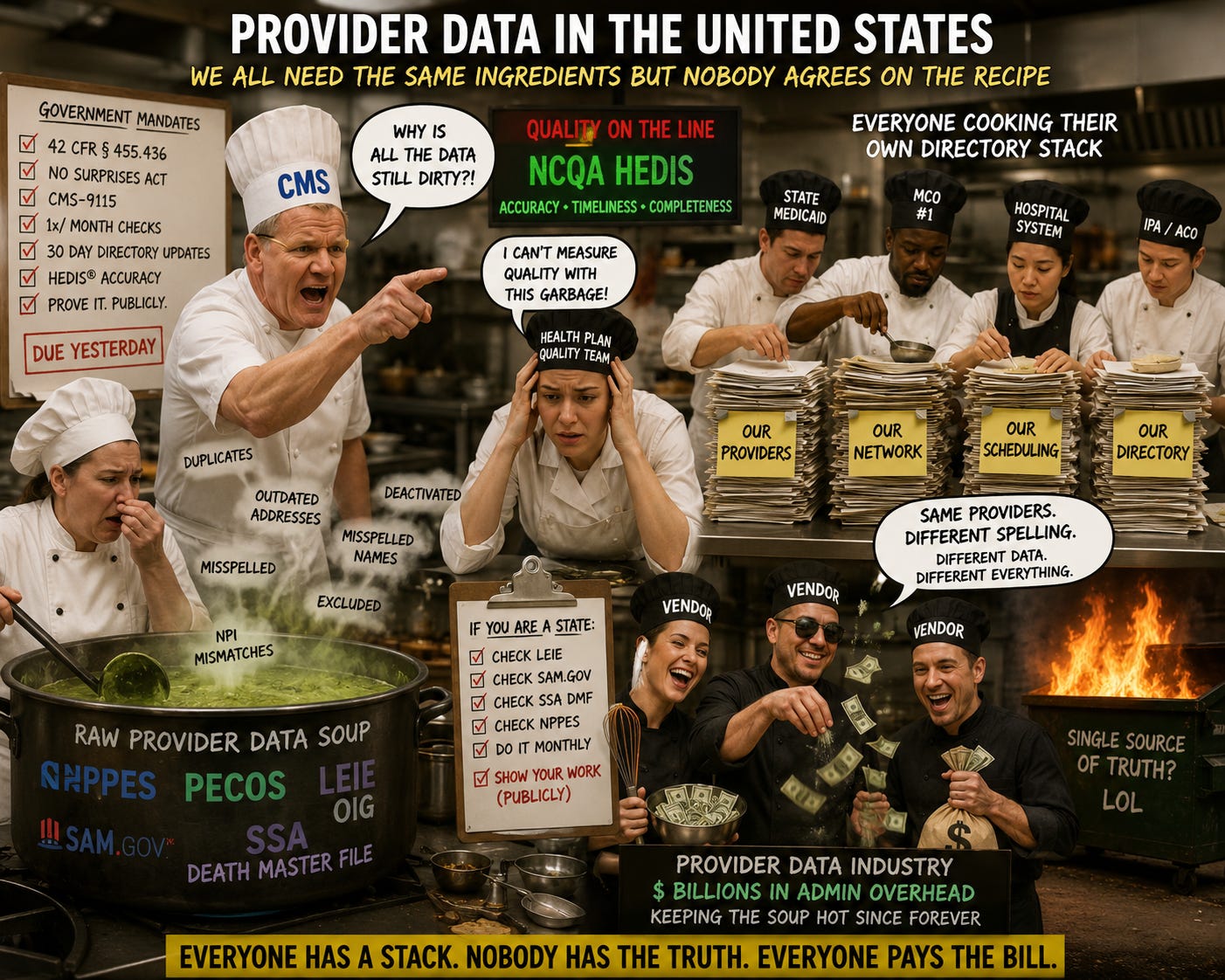
If you are a state Medicaid agency, the law (42 CFR § 455.436) requires that you do these cross-checks monthly. NPPES. LEIE. SAM.gov. SSA Death Master File. If you are a Medicare Advantage or Medicaid managed care plan publishing a provider directory, the No Surprises Act and CMS-9115 require that you update yours every thirty days and answer for what is in it. If you are a patient trying to choose a specialist for your parent, you are at the end of all of it, with no public-facing way to know whether anyone has actually scrubbed the directory you are about to use.
I have started calling this directory fibrillation. The federal directory, fifty state Medicaid rosters, every payer directory, every credentialing platform: each one maintains its own copy of who is in good standing, each one contracts on its own rhythm, and none of them share a cross-reference against the federal exclusion data they are all supposed to honor. Every team firing independently. Nothing coordinated. The system burning energy without moving anything forward.
WHAT CHANGED ON APRIL 23
On April 23, 2026, CMS Administrator Dr. Mehmet Oz sent a letter to every state governor and a parallel State Medicaid Director Letter directing every state to undertake “a swift revalidation of Medicaid providers of services at high risk of waste, fraud, abuse, and corruption.”
Ten business days to commit. Thirty days to submit a comprehensive two-year provider revalidation strategy. Five required elements, including the one that matters for everything I am about to describe: metrics to measure effectiveness and progress, including links to any public-facing data or reporting.
The legal obligation to scrub Medicaid provider rosters against federal exclusion lists has been in place for fifteen years. What changed in April is that the federal government is now asking states to show their work. The state Medicaid director who responds with “yes, we check monthly per § 455.436” without any public-facing evidence of what those checks find is responding inadequately, because the letter explicitly asks for the public-facing evidence.
The federal directory those states are supposed to be checking against contains, in its current published release, more than eight thousand excluded practitioners. The state is supposed to detect this every month, on its own, without help from the directory itself. The asymmetry is the point.
I HAVE BEEN SCRUBBING PROVIDER DATA FOR A DECADE
When I worked at UPMC’s Wolff Center on quality and patient safety reporting, scrubbing provider data feeds was the slog underneath every measure we published. Manual Excel sheets. Cognos queries. SQL Server pulls. Microsoft Access databases. The reports came out the door, but the data underneath them never felt finished.
At UPMC Health Plan as a manager of the quality analytics team responsible for the annual HEDIS submission, I learned how big the problem actually is. HIE data, EMR data pulled across forty UPMC hospitals, credentialing-department sprints, cross-audits, vendors arriving every quarter with additional data points. None of it ever got provider data quality much above an eighty percent average. The HEDIS industry itself is built around this gap. Hundreds of chart abstractors. Dozens of vendors. An NLP startup (Astrata) spun out of UPMC trying to use language models to recover what the structured data could not.
At b.well Connected Health, the use case shifted to consumer-facing, but the underlying problem did not. A patient should be able to search and find their own provider, and the data behind that search should be scrubbed, joined across sources, represented in the latest FHIR profiles and implementation guides, and carry the endpoints a patient needs to exercise their right of access under CMS-9115. Putting that together was years of work, against the same underlying directory data quality problem that has been there the entire time I have been in healthcare technology.
That is why the National Provider Directory matters more than any single CMS interoperability artifact in the last decade. For the first time, CMS is reviewing its own provider data in public. There are weekly Zoom calls with industry. Architectural decisions are being made on GitHub. The administration change earlier this year specifically prioritized the NPD inside the CMS health-tech ecosystem, and the work has accelerated. I want AINPI to help move that forward. Not as an adversary to the directory team. As the independent, public-domain audit layer the federal directory has needed since long before this release dropped, and that state Medicaid agencies can use this month to respond to the HHS letter.
WHAT WE BUILT WHEN WE COULD SEE WHAT WAS IN THE DIRECTORY
When the April release dropped, I pulled the structure apart. The methodology I had been drafting since 2025 produced its first reproducible findings within the week. Six DAMA data-quality dimensions. Structural validation against the NDH Implementation Guide. Referential integrity. Endpoint liveness. Temporal analysis. Identity correctness against NPPES and NUCC. The work lives at ainpi.dev, free and open source under Apache 2.0. Every finding is pre-registered: null hypothesis, denominator, source release tag, methodology version stated before the query runs.
The directory-side findings are the first wave. Twenty-eight published, numbered H1 through H28. Endpoint URL validity. Referential integrity. Duplicate detection. NPI Luhn correctness. NPPES match rate. OIG LEIE exposure. SAM.gov exposure. Social Security Number exposure in the qualification slot. Each finding gets a pre-registration page, a state-by-state cohort export, and verification URLs that a program-integrity analyst can use directly against the federal portals.
The most important thing about the methodology is that none of it requires restricted data. The cross-checks use NPPES, LEIE, SAM.gov, and a handful of public payer FHIR directories. There is no Data Use Agreement involved. There is no procurement path that gates any of it. The data is sitting on federal websites, refreshed on a published cadence, free for download. The only thing that has been missing is somebody doing the work, in public, on a stable URL, with the methodology source-controlled.
THE VIRGINIA CUT
Virginia was the first state I drilled into in detail. By May 4 the per-state findings page included a 131-NPI federally excluded VA-resident cohort, a four-MCO payer-directory exposure sweep across Humana, Cigna, UnitedHealthcare, and Molina Complete Care, an NPPES-deactivation flag count for the state, a directory duplicate-detection breakdown, and a draft citation paragraph any state Medicaid agency could adapt for an SMD-letter Element 2 response.
The directory-side cut was complete. The obvious next question was the one the public data could not yet answer. Once a provider is excluded from federal programs, the directory keeps them listed. But does the federal payment side keep paying them? Was the gate that should have closed actually closed?
That question is what produced the second wave.
THE WEEK WE SHIPPED THE CLAIMS-SIDE AUDIT

Until February 2026, the question that comes after “who is in the directory who shouldn’t be” was effectively unanswerable from public data. The question of who got paid required a Data Use Agreement, a ResDAC procurement, and a federal sponsor. T-MSIS Analytic Files are restricted. CMS Common Working File research files are restricted. The Preclusion List is restricted to Medicare Advantage and Part D plans.
Then HHS published the Medicaid Provider Spending dataset on opendata.hhs.gov. NPI-keyed. Fee-for-service and managed care. Every state, DC, and the territories. Calendar years 2018 through 2024. The first public, provider-level Medicaid spending file ever released. Medicare Part B and Part D files continue to publish at NPI granularity on data.cms.gov. Open Payments, DMEPOS, Provider of Services, Nursing Home Compare ownership. All already public. All NPI- or CCN-joinable.
The claims-side cross-audit became feasible from public data only. So in the week between May 7 and May 14, I shipped the roadmap and the first findings.
Eight pre-registered hypotheses, joining AINPI’s directory-side cohort against every freely available NPI-keyed federal dataset I could find. Excluded providers paid by Medicaid. Excluded providers billing Medicare Part B. Excluded providers prescribing under Medicare Part D. NPPES-deactivated providers still billing across any public dataset. Excluded providers receiving industry payments under the Sunshine Act. DMEPOS suppliers on federal exclusion lists. Nursing home, hospice, home health, and hospital ownership against exclusion lists. High-volume Medicare Part B billers absent from the federal directory entirely.
The first finding published the same day the roadmap landed. Against the Virginia cohort: twenty-eight of one hundred twenty-five currently active federally excluded VA-resident NPIs received Medicaid payments somewhere in T-MSIS between 2018 and 2024. Eight and a half million dollars across more than two hundred thousand claim lines.
The strict-post-exclusion number is zero. That is the count of claim months strictly after the LEIE or SAM effective date. Once an exclusion takes effect, the federal payment gate mostly holds. The directory-side gate, which is supposed to make sure these providers are not still listed as practitioners in good standing to patients and payers downstream, is the one that does not.
The nursing-home finding is the one that haunts me. Zero confirmed NPI matches nationally, because exclusion forces Medicare revocation and most excluded NPIs are no longer in the Medicare Provider Enrollment File. But the demographic match returned more than seventeen hundred candidate rows. Facility owners whose name and state align with someone on a federal exclusion list. Seventeen of those rows are in Virginia. The CMS Disclosure of Ownership Interim Final Rule was specifically designed to surface this pattern. The data has been public for two years. No one had published the cross-check.
THE ACTIVATION ENERGY PROBLEM
The reason this kind of work has not been done at the federal-directory level is not ignorance. It is the economics of the work itself.
Standing up a multi-source audit requires NPI normalization, weekly refresh against LEIE, monthly refresh against SAM, careful handling of entity-type filters so you do not over-flag state and county health agencies and high-volume institutional NPIs, attention to exclusion-effective dates so strict-post-exclusion gets separated from full-window matches, and a publication contract that exposes findings as both static JSON and per-state CSV with verification URLs to the federal portals. The crawler has to be polite. The terminology server has to be local so you do not rate-limit tx.fhir.org. Every finding has to be reproducible from a clean checkout against a pinned source release.
It is not intellectually demanding work. It is just relentlessly tedious, and high-stakes. Wrong-flag an active provider as excluded and you have done real harm.
The federal directory team is serious, well-staffed, and improving. The SSN exposure dropping from 46 to 41 between two consecutive releases shows that someone is scrubbing. But “they will get there” is a multi-year timeline, the states are being asked to revalidate in thirty days, and the patients are downstream of all of it right now.
There is a category of accountability infrastructure that has to exist outside the agency it is auditing. Not because the agency is acting in bad faith. Because that is what independent verification means. The published auditor cannot be the same team as the published audited.
WHAT BECOMES POSSIBLE WHEN THE AUDIT IS PUBLIC
When the per-state CSV is downloadable at a stable URL, the methodology is open source, and the source release is pinned to a tag a state can reproduce on its own laptop, the conversation with the state Medicaid agency changes.
A program-integrity director who would have spent six months negotiating a data-sharing agreement to get this work done internally can instead pull the CSV today and feed it into the MMIS reconciliation queue. The citation language for the SMD-letter response is already written. The verification URLs in the CSV link directly to NPPES, LEIE, and SAM, so a state PI analyst can independently verify any row in seconds. Virginia is the most worked-through state cut today, but the underlying cohort data is now published for every state. The per-state findings landing page is at ainpi.dev/for-state-medicaid, and any state Medicaid agency can pull their cohort, their NPPES-deactivation count, their MCO exposure sweep, and their claims-side cross-audit slice today without contacting me first.
That is not an incremental efficiency gain. That is a different category of state operational capability.
Pennsylvania and South Carolina are next in line for detailed state cuts, but every state Medicaid program in the country is preparing an SMD response right now, with the May 23 deadline five days from this writing, and every one of them can use this work as a published Element 2 input today.
THE DIRECTORY HAS NO SERVICES LAYER
The audit work is one half of what AINPI is doing. The other half is participating in the CMS NPD working group calls that meet weekly to shape what the next release of the directory will model. The most consequential open question on those calls right now is HealthcareService, the FHIR resource that is supposed to describe what a provider actually does, not just where they are and how to reach them.
The current NPD release ships six resource types. HealthcareService is not one of them. The NDH Implementation Guide at HL7 defines a HealthcareService profile, but the definition is still vague at the field level, the binding decisions are still open, and the working group has not yet decided which payer-side data feeds will be authoritative for which fields. A patient searching the directory today can find that Dr. X is a cardiologist in Philadelphia. They cannot find that Dr. X performs ablations but not implants, accepts new pediatric cardiology consults but not adult cardiac rehab, runs a chest-pain clinic on Thursdays, and bills Medicare Advantage but does not accept Medicaid managed care. That second layer is what HealthcareService is for, and it is the layer the directory does not yet have.
To inform what that layer should contain, AINPI published a public survey on payer healthcare service utilization. The audience is broad. Payer data architects. Network management teams. Provider operations staff. FHIR IG contributors. The patient and consumer advocates who will be downstream of whatever the working group decides. The goal is to model HealthcareService once, uniformly, so that payers can submit it to CMS in a consistent shape, CMS can publish it as part of the federal directory, and downstream payer APIs can surface it publicly under CMS-9115 with the same field semantics across every plan. Today no one has agreed on what that looks like. If you have anything to share, the survey is the input channel. What you wish your payer’s directory captured. What your team finds painful to extract from claims. What your patients actually ask when they search.
WHY THIS HAS TO BECOME ONGOING
The work of independent accountability is the work of showing up every month with the new numbers. Yubin Park does this on LinkedIn. Specific findings. Named datasets. Public methodology. A drumbeat. That is the cadence that works. Not occasional thinkpieces. Not annual reports from a research center.
ainpi.dev now publishes a release update every time CMS ships a new NDH bulk export. Every weekly refresh of LEIE and SAM updates the cohort. Every new state cross-audit is a state-scoped CSV at a stable URL. The next NDH release drops in June. The audit will be waiting.
This week I am posting a YouTube walkthrough. What the directory contains. What the audit finds. How a state Medicaid PI office can use the per-state CSV today. Same numbers, different surface, more reach. The audience most affected by this work is also the audience least able to find it: the families choosing nursing facilities, the patients picking specialists, the program-integrity analysts in state offices who do not have time to build their own audit infrastructure but can absolutely use one if it is sitting on a public URL with the methodology in plain view.
THE ASK IS NOT TECHNICAL
The question to ask your state Medicaid director, your chief compliance officer, your CMO, your patient advocacy lead, is not technical. It is simply: do we know what is in our provider directory? And if not, what would it take to find out?
The data is free. The methodology is open. The findings are pinned to release tags for audit reproducibility. Every state Medicaid agency in the country can cite this work in their SMD response on Monday.
The audit is at ainpi.dev. The source is at github.com/FHIR-IQ/AINPI. The per-state Medicaid landing page is at ainpi.dev/for-state-medicaid. The cross-audit roadmap is at ainpi.dev/smd-revalidation/cross-audit-roadmap. The payer HealthcareService survey is at ainpi.dev/payer-healthcare-service-survey. I am at gene@fhiriq.com.
If you are inside a state Medicaid agency, a payer compliance team, or a hospital credentialing office and any of this is useful to you, please reach out. The next release drops in June.
Gene Vestel writes about FHIR-based health data infrastructure, AI-assisted development, and product strategy at the FHIR IQ Playbook. He builds at FHIR IQ and Healthclaw, and runs ainpi.dev, a free public audit of the CMS National Provider Directory.
If you are working on provider directory data quality, state Medicaid program integrity, or FHIR-based audit infrastructure, connect on LinkedIn or reach me directly at gene@fhiriq.com.
Discussion about this post