The Entropy of Modern Medicine: Why Healthcare Data Remains the Primary Bottleneck

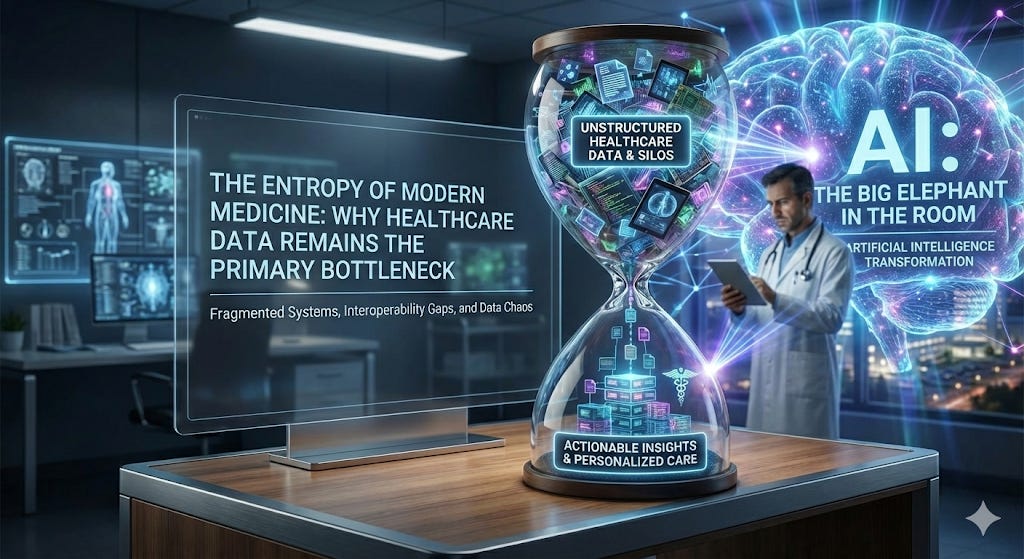
The global healthcare ecosystem in 2025 exists in a state of profound cognitive dissonance. On one hand, the industry is witnessing an unprecedented "Gold Rush" of capital and enthusiasm directed toward artificial intelligence, promising a future of autonomous diagnostics and hyper-personalized medicine. On the other hand, the foundational substrate of this innovation healthcare data remains fundamentally fractured and characterized by high entropy. This report examines the structural crisis of medical information, the maturation of data tools, and the historical context of speculative bubbles.
The assertion that healthcare data is currently inadequate for the demands of the twenty-first century is a quantifiable systemic failure. Despite the widespread adoption of Electronic Health Records (EHR), the industry suffers from a lack of semantic interoperability and a crisis of trust in information generated outside institutional walls.
The Crisis of Trust and Data Quality
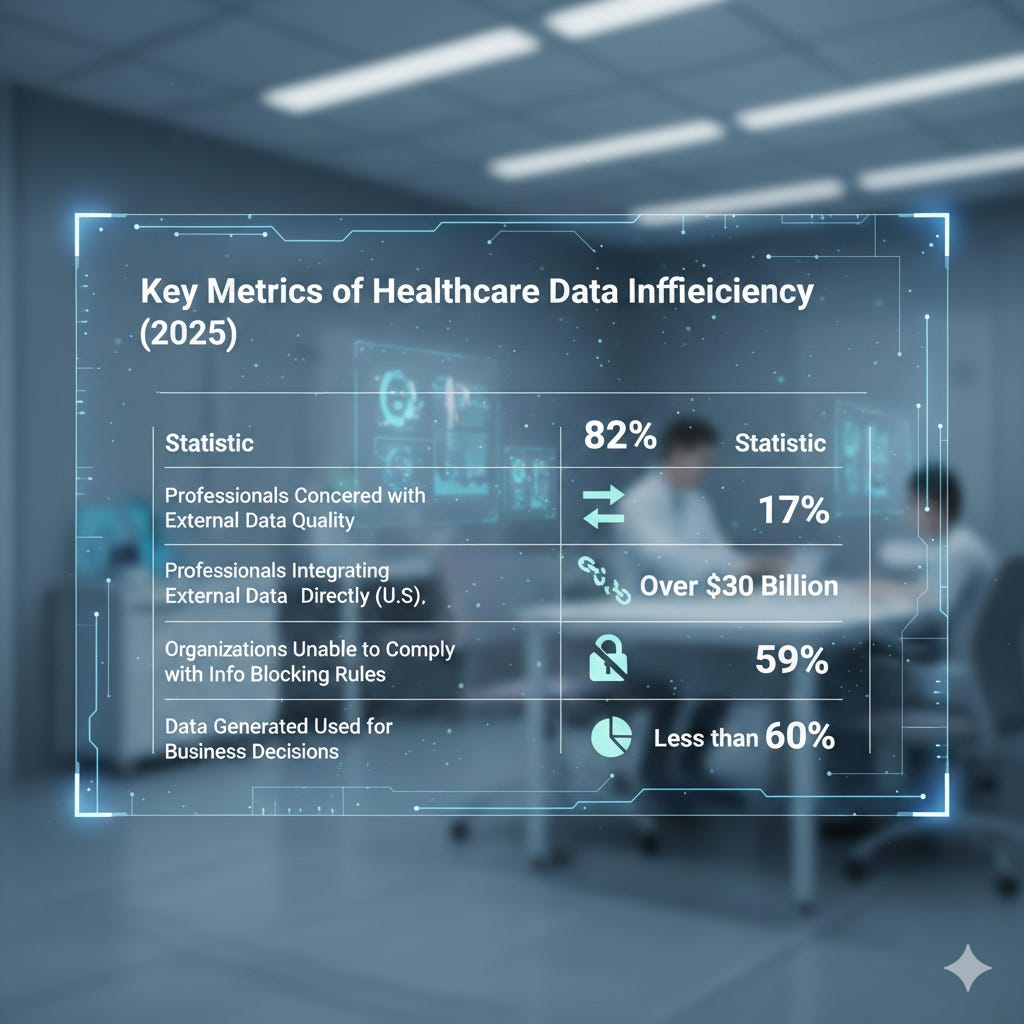
In 2025, the medical community's relationship with external data is defined by skepticism. Research among healthcare leaders indicates that 82% of professionals are concerned about the quality of data received from external sources. This lack of confidence has created a "trust gap" where only 17% of professionals integrate external patient information directly into their systems, with the vast majority opting for manual review. Symptoms of poor data quality include delayed onboarding, manual workarounds, and an erosion of trust in performance metrics.
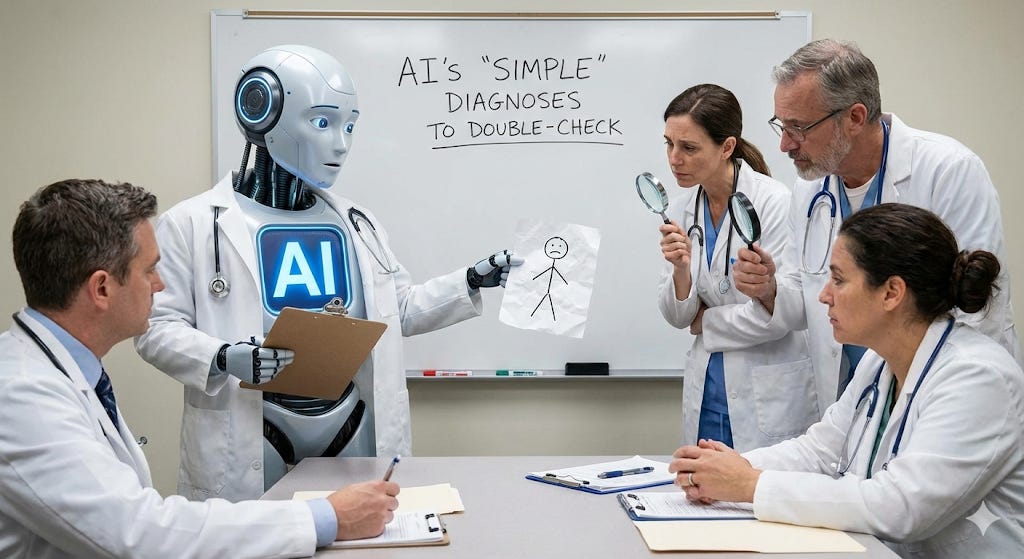
For clinicians, volume has surpassed human capacity. A single hospital generates approximately 137 terabytes of data daily, and each patient accumulates roughly 80 megabytes annually. Consequently, 66% of survey participants in 2025 reported concerns regarding provider fatigue related to external data integration. When data is poor, AI models become unreliable or dangerous, leading organizations to "double and triple-check" AI-generated outputs.
The "Data Gravity" of Entrenched EHRs
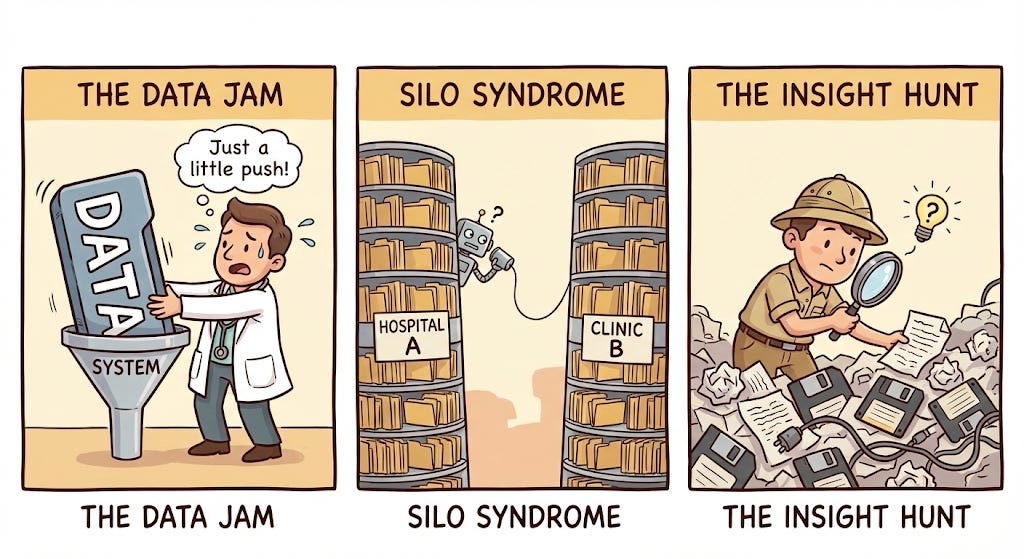
A critical structural barrier, emphasized by Brendan Keeler, is the concept of "data gravity". While many view the current AI wave as a means to disrupt legacy EHRs, these systems remain "sticky" because switching costs comprising massive data migration and workforce retraining are measured in decades rather than funding cycles. Many healthcare information systems remain isolated ecosystems, with 57% of physicians identifying interoperability as the primary hurdle to maximizing health IT. This fragmentation forces physicians to work with incomplete medical histories, leading to redundant testing and diagnostic errors.
The Technical Renaissance: Tools and the "Sausage-Making" of Policy
While the diagnosis of healthcare data is bleak, the treatment plan is becoming more sophisticated through a combination of maturing tools and aggressive regulatory "sausage-making" the messy process of policy and litigation.
Standardized Interoperability and the "On-Ramp" Era
The HL7 Fast Healthcare Interoperability Resources (FHIR) standard has emerged as the definitive backbone for next-generation technology. FHIR facilitates data exchange via modern APIs, reducing manual work and errors. By 2025, regulatory mandates like the 21st Century Cures Act and CMS rules have forced providers to upgrade pipelines to support the latest data standards (e.g., USCDI v3).
Per Brendan Keeler real progress is currently driven by three forces:
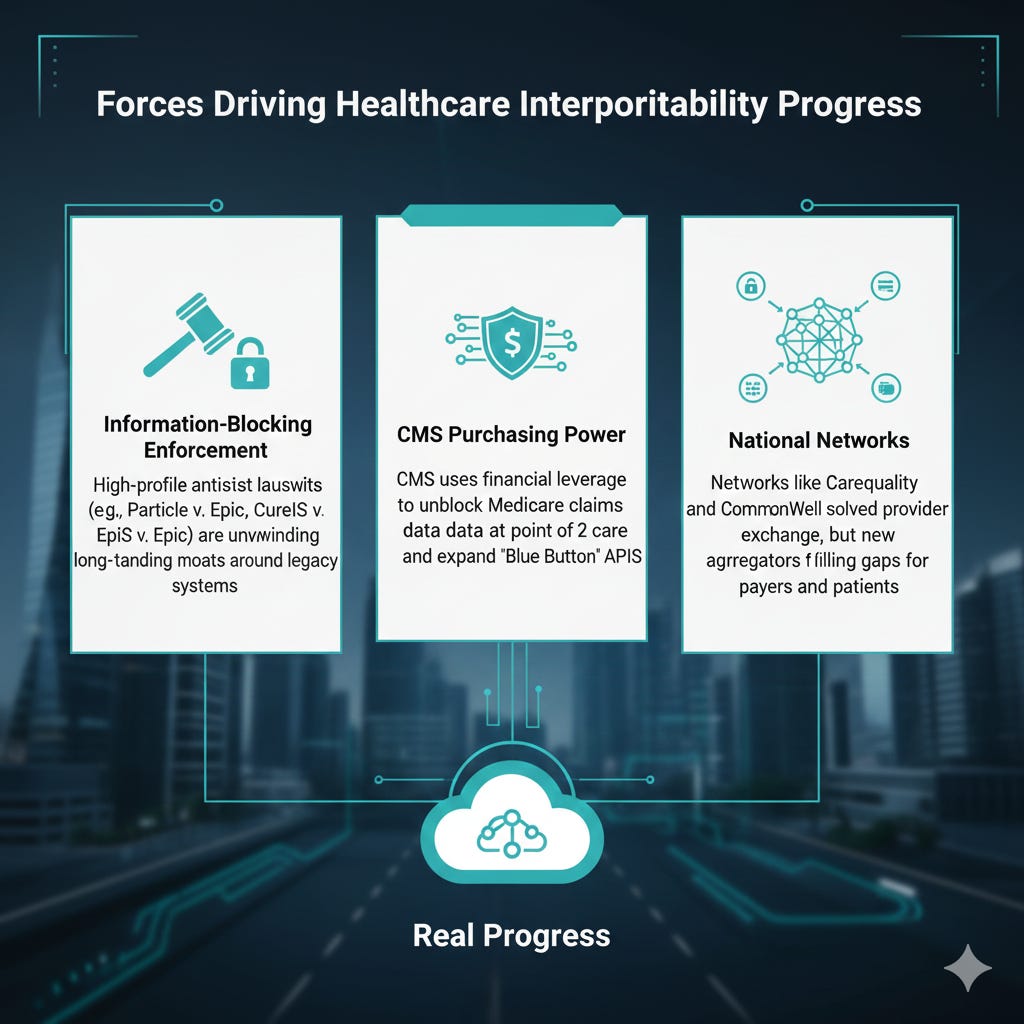
* Information-Blocking Enforcement: High-profile antitrust and information-blocking lawsuits (e.g., Particle v. Epic, CureIS v. Epic) are starting to unwind long-standing moats around legacy systems of record.
* CMS Purchasing Power: CMS is using its financial leverage to unblock Medicare claims data at the point of care and expand "Blue Button" APIs.
* National Networks: Networks like Carequality and CommonWell have largely solved provider-to-provider exchange, but have exposed new gaps for payers and patients that new "on-ramp" aggregators are now filling.
The Diffusion Gap: Why Organizations Are Not Adapting Fast Enough
The "Diffusion Gap" in healthcare is caused by financial constraints, rigid institutional hierarchies, and a cultural prioritization of risk mitigation over innovation.
Structural and Cultural Barriers
In 2025, U.S. health system operating margins have narrowed to historic lows. Consequently, 38% of organizations cite high costs and labor shortages as the primary barriers to adoption . Cybersecurity has also returned as the top priority for 60% of leaders following major attacks, often pushing AI adoption to a secondary concern .
Resistance to change is deeply embedded; many clinicians view new technologies as additional burdens that disrupt established workflows. This is exacerbated by a lack of digital transformation roadmaps less than 30 % of U.S. providers had one as of late 2023. The enterprise EHRs remain "sticky" because the effort required to retrain staff and migrate data is immense, making "incremental layering" of standards more effective than radical disruption.
The Anatomy of the Bubble: Learning from Historical Speculation
The current "Gold Rush" mentality surrounding AI bears striking similarities to historical economic bubbles.
Historical Comparisons
* The Dutch Tulip Mania (1633–1637): A "greater fool theory" bubble driven by irrational price increases for tulip bulbs . The lesson for AI is the danger of investing in "intrinsically useless" or non-productive assets where price is disconnected from utility .
* The California Gold Rush (1848–1855): The "picks and shovels" model . In 2025, companies like Nvidia are the "sellers," profiting from the infrastructure needed to build models while many "miners" (individual startups) fail to find gold .
* The Dot-com Bubble (1995–2000): Fueled by excitement over internet commercialization . While paper wealth was erased, it left behind the physical infrastructure (fiber optics) that allowed later giants to thrive . Similarly, the AI bubble is leaving behind massive data center capacity.
How AI is Different: The "Unmakeable Math" and the Productivity Unlock
While "Gold Rush" labels apply, the 2025 AI cycle is different because the "borrowers" are the wealthiest companies in history (Amazon, Microsoft, Google) .
The Productivity Dividend vs. CapEx
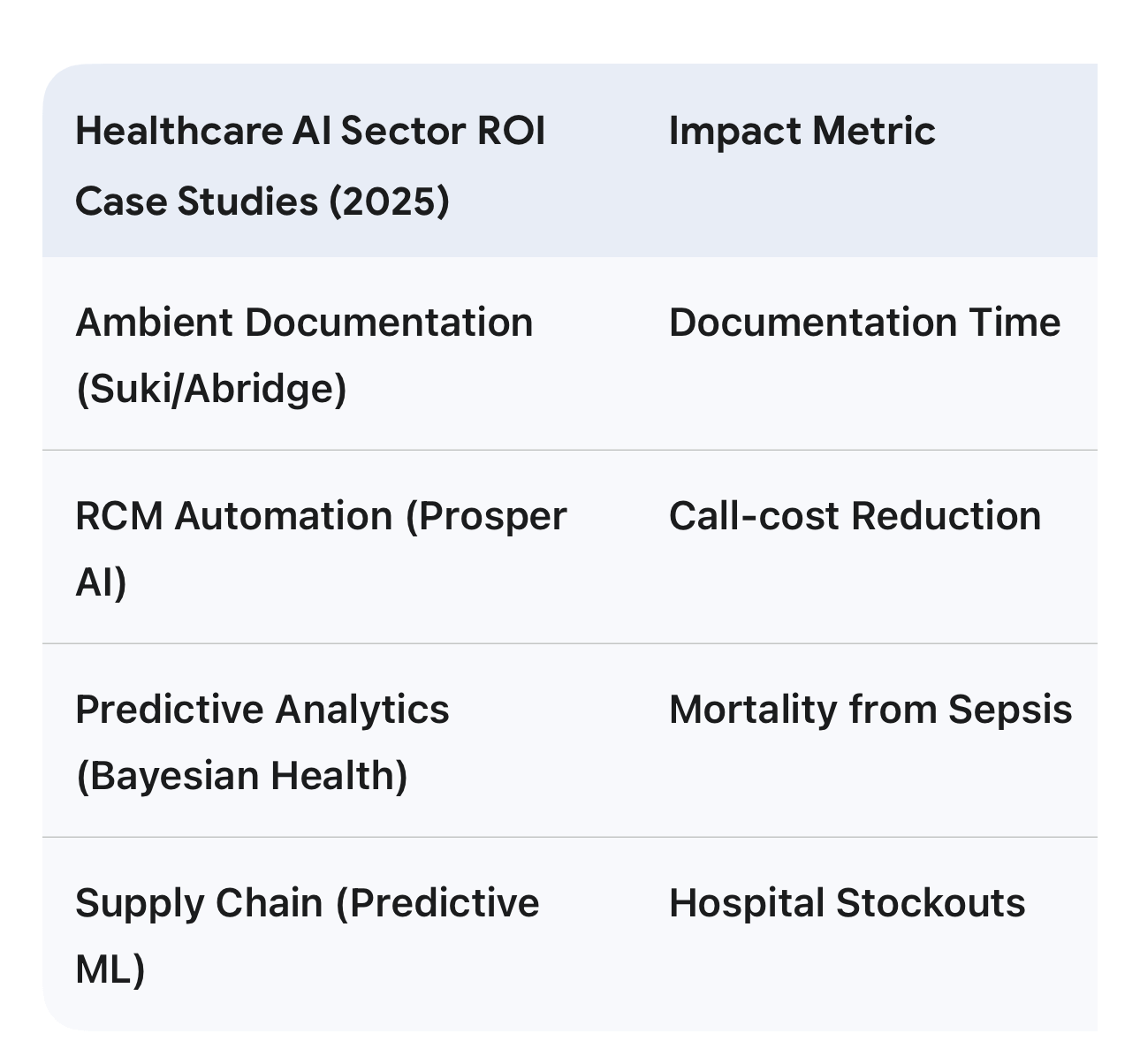
Industry spending is projected to reach $8 trillion for 100 GW of computing capacity. Critics warn this "math just doesn't add up" for ROI under current monetization. However, unlike the 2008 housing crisis where assets were non-productive, GPUs and data centers are "productive assets" designed to generate direct cash flow by providing computing power . AI is already demonstrating ROI in "unsexy" areas like documentation and revenue cycle management (RCM).
Lessons for Healthcare Technology Companies, Builders, and Investors
The "Gold Rush" is volatile, but those focusing on infrastructure and defensibility will survive the correction.
Building Defensible Data Moats
Sustainable competitive advantage in 2025 must be built on three pillars :
* Proprietary Data Advantage: Access to unique, high-quality datasets (genomic, longitudinal notes) is the most powerful moat.
* Workflow Integration: Tools deeply embedded in the EHR create high switching costs.
* Regulatory/Compliance Moats: Mastering FDA approvals and HIPAA/GDPR provides a first-mover barrier against less sophisticated competitors.
Strategic Imperatives for Builders and Investors
* Avoid the "System of Action" Trap: Watch out for fallacy that new "systems of action" (clean UIs) will easily replace EHRs. Instead, build for the "Integration Gap" the $43 billion opportunity to make existing tools work seamlessly across the 2000+ software systems used by typical hospitals.
* Prioritize "Unsexy" Infrastructure: The most sustainable profits are often found in "picks and shovels" like FHIR-native storage, MLOps tools, and RCM automation.
* Don't Build Your Own Master Patient Index (eMPI): Lean on existing on-ramps and aggregators; building internal infrastructure for things that already exist (like authentication, security, identity or patient indexes) is an inefficient use of capital.
* Embrace the "Sausage-Making": Understand that progress in healthcare isn't just about code; it's about navigating the bipartisan layering of HIPAA, the Cures Act, TEFCA foundations, CMS Aligned Networks, fast iterative solutions instead of long dev cycles are the name of the game.
The Architecture of Sustainable Value
The diagnosis for 2025 is a state of data entropy and speculative frenzy. However, the maturation of standards based frameworks like FHIR and the productive nature of AI assets suggest this is not a repeat of the Dutch Tulip Mania. It is a technological cycle that will likely see a correction but leave behind a transformed care infrastructure. The builders who survive will be those who treat interoperability not as a compliance burden, but as a strategic capability, moving past the hype toward the "sausage-making" reality of a connected healthcare ecosystem solving every day problems for patients, providers and caregivers.
Discussion about this post