The Cognitive Asymmetry: Why Patients Need a "Copilot" More Than Providers Do
Healthcare has spent the last decade solving for data access, operating under the assumption that if we gave patients their data, they would become empowered.

Healthcare has spent the last decade solving for data access, operating under the assumption that if we gave patients their data, they would become empowered.
We were wrong. We didn’t empower patients; we overwhelmed them.
This is why Halle Tecco argues that patients should have access to Medical Grade AI.
While we were busy forcing interoperability standards to move raw FHIR bundles from Point A to Point B, the rest of the digital world moved on to solving cognitive load. Consumer platforms like Rocket Money or Uber didn’t win by giving users raw database access; they won by translating complex back-end logic into simple, contextual narratives.
We are now entering a dangerous era of Cognitive Asymmetry.
Clinicians are receiving sophisticated AI “scaffolding” tools like OpenEvidence, Doximity DocsGPT, and EHR copilots that summarize, interpret, and guide decision-making (they simplify their roles). Meanwhile, patients are still receiving the digital equivalent of a file dump: CCDA Documents via scattered PDFs,15,000 raw FHIR Observation lab values with generic reference ranges, and cryptic portal messages that lack context as well as litany of encounter notes with no context.
We are building a future where clinicians operate with superpowers and patients operate blindfolded.
To fix this, we must stop building “portals” and start building a Patient Cognition Layer.
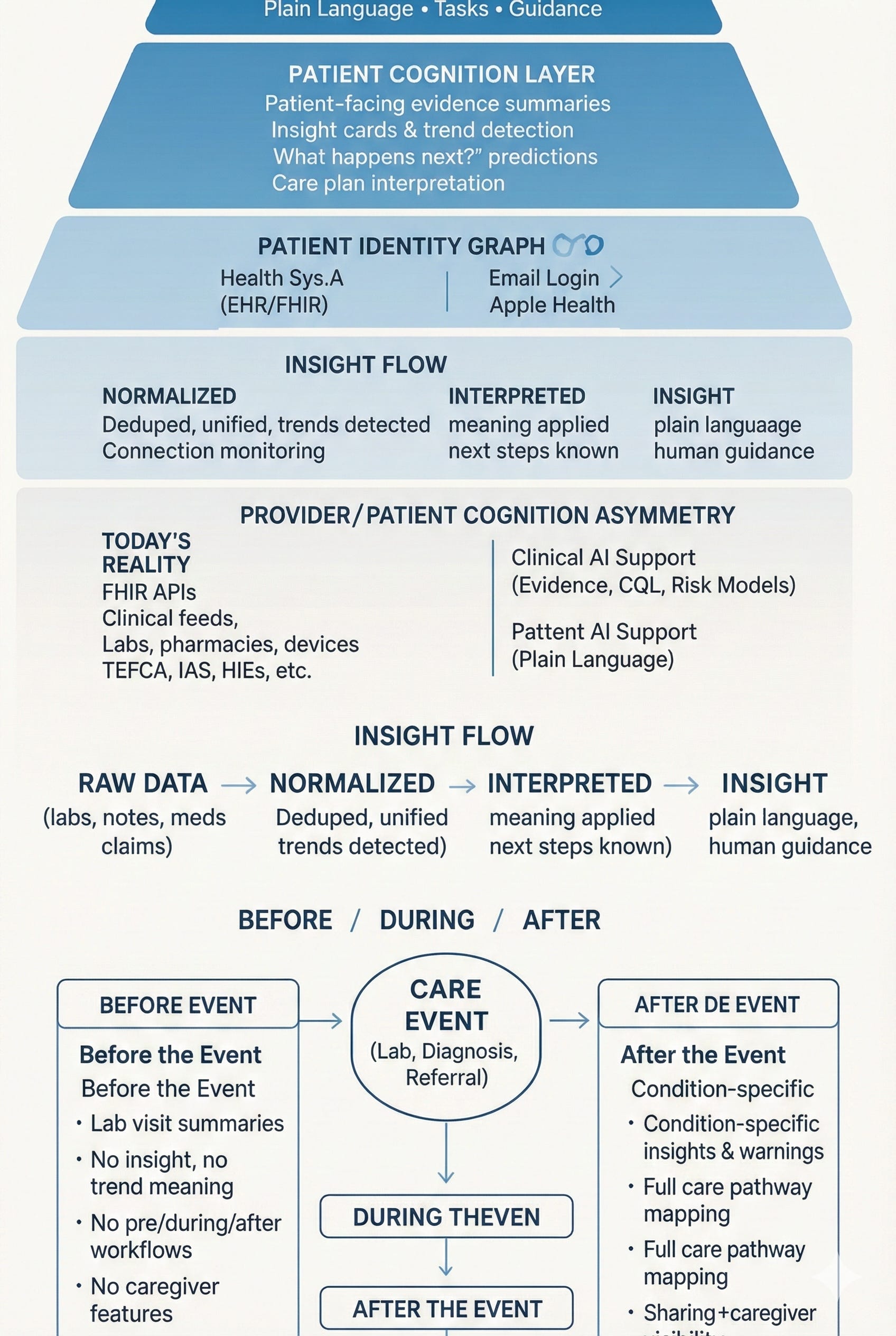
Here are the four pillars of a cognitive layer.
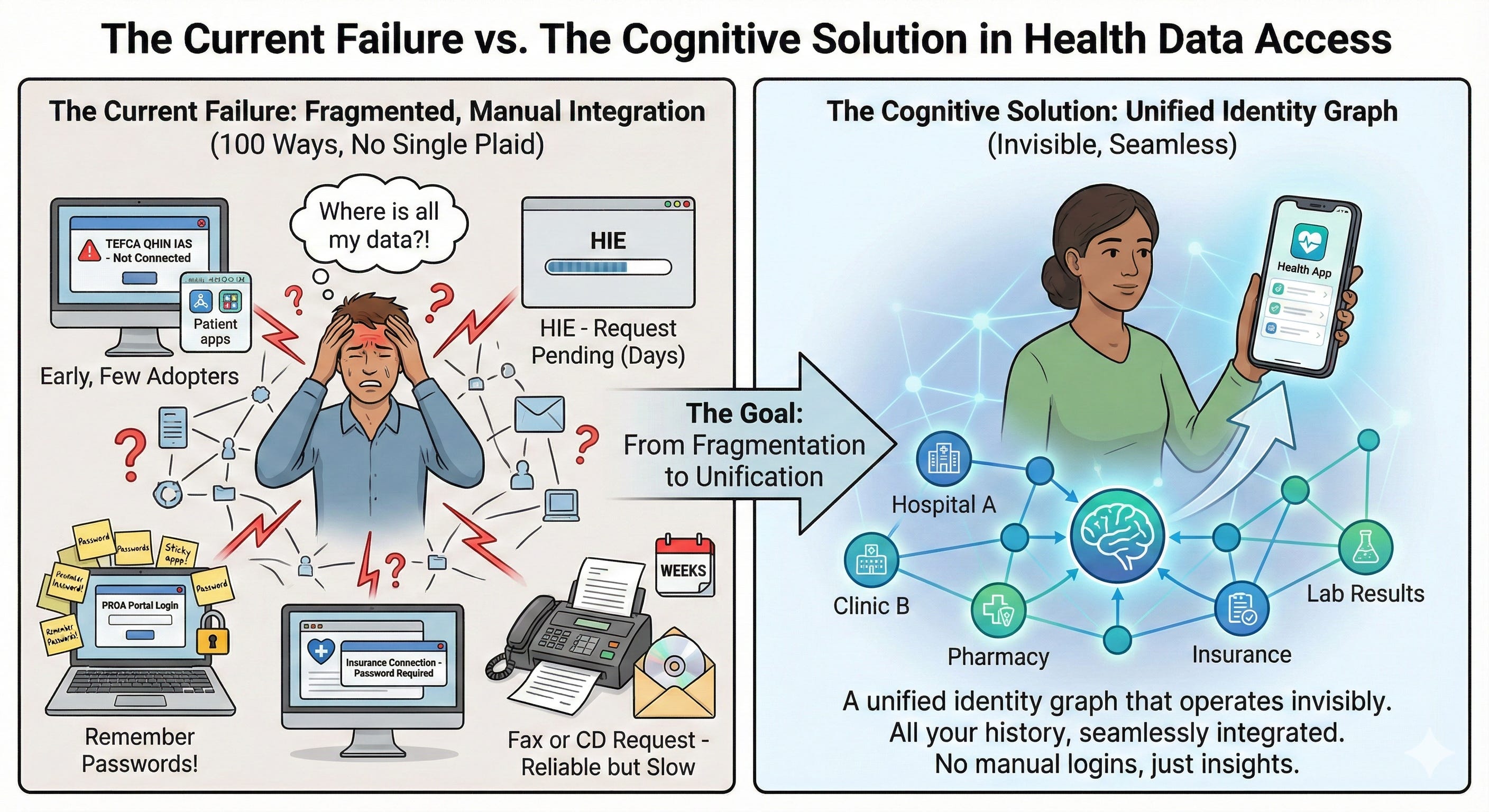
1. Identity Resolution (The “You” Graph)
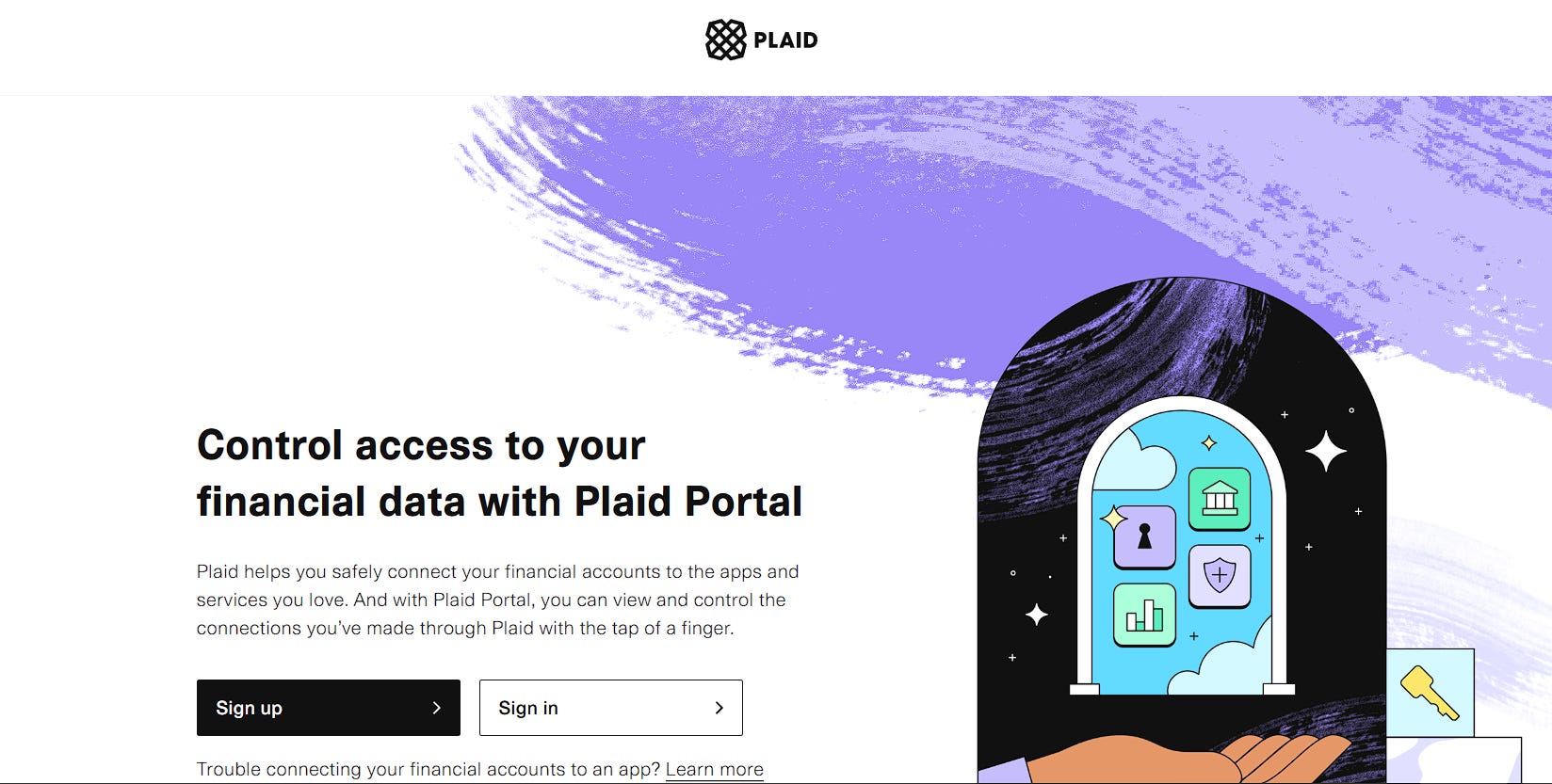
The Current Failure: Patients are forced to act as manual API integrators, logging into disparate portals to piece together their own history. The Cognitive Solution: A unified identity graph that operates invisibly ( or Plaid for healthcare).
2. Semantic Normalization (Translation, Not Aggregation)
The Current Failure: A patient receives a notification: “WBC 11.4 (H).” This induces anxiety, not understanding. The Cognitive Solution: Narrative generation.
Data aggregation what most “Plaid for Healthcare” startups are actually doing is insufficient.
“Your white blood cell count is slightly elevated. This often occurs with infection, inflammation, or stress. Here is what is typically monitored next.”
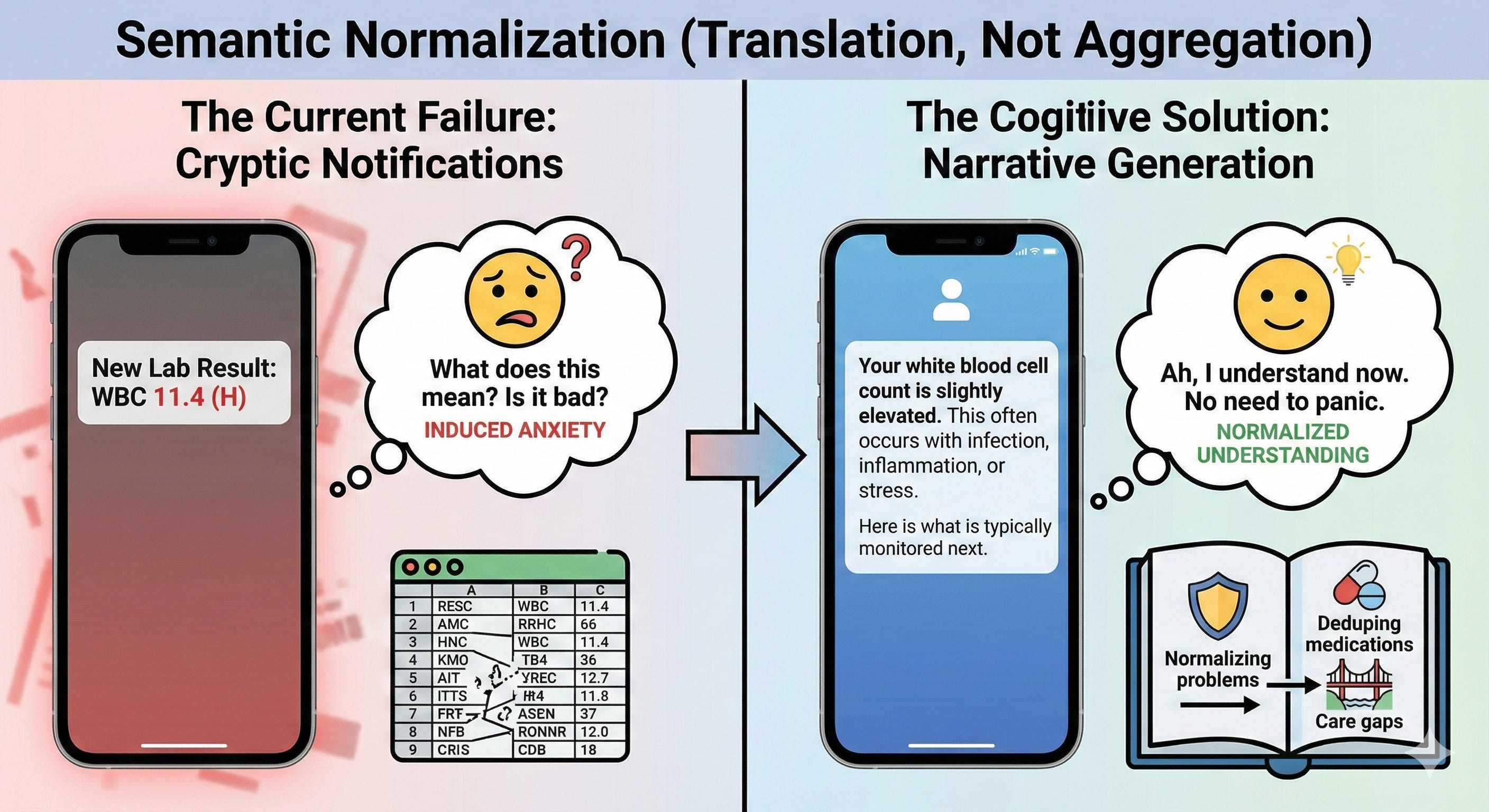
This approach normalizes problems, dedupes medications, and identifies care gaps, presenting them not as a spreadsheet, but as a story. Patients deserve to understand their health status without requiring a medical degree to interpret the syntax.
3. Contextual Insight (The “So What?” Engine)
The Current Failure: Static data. A list of conditions or past appointments tells the patient nothing about their current risk or required actions. The Cognitive Solution: Dynamic Insight Cards.
We need to answer the question patients are too afraid to ask: “What does this actually mean for me right now?”
Instead of a passive list, the system must generate active insights:
“Your A1C has drifted upward over 12 months—here are three questions to ask your endocrinologist.”
“You are missing a follow-up on your last referral.”
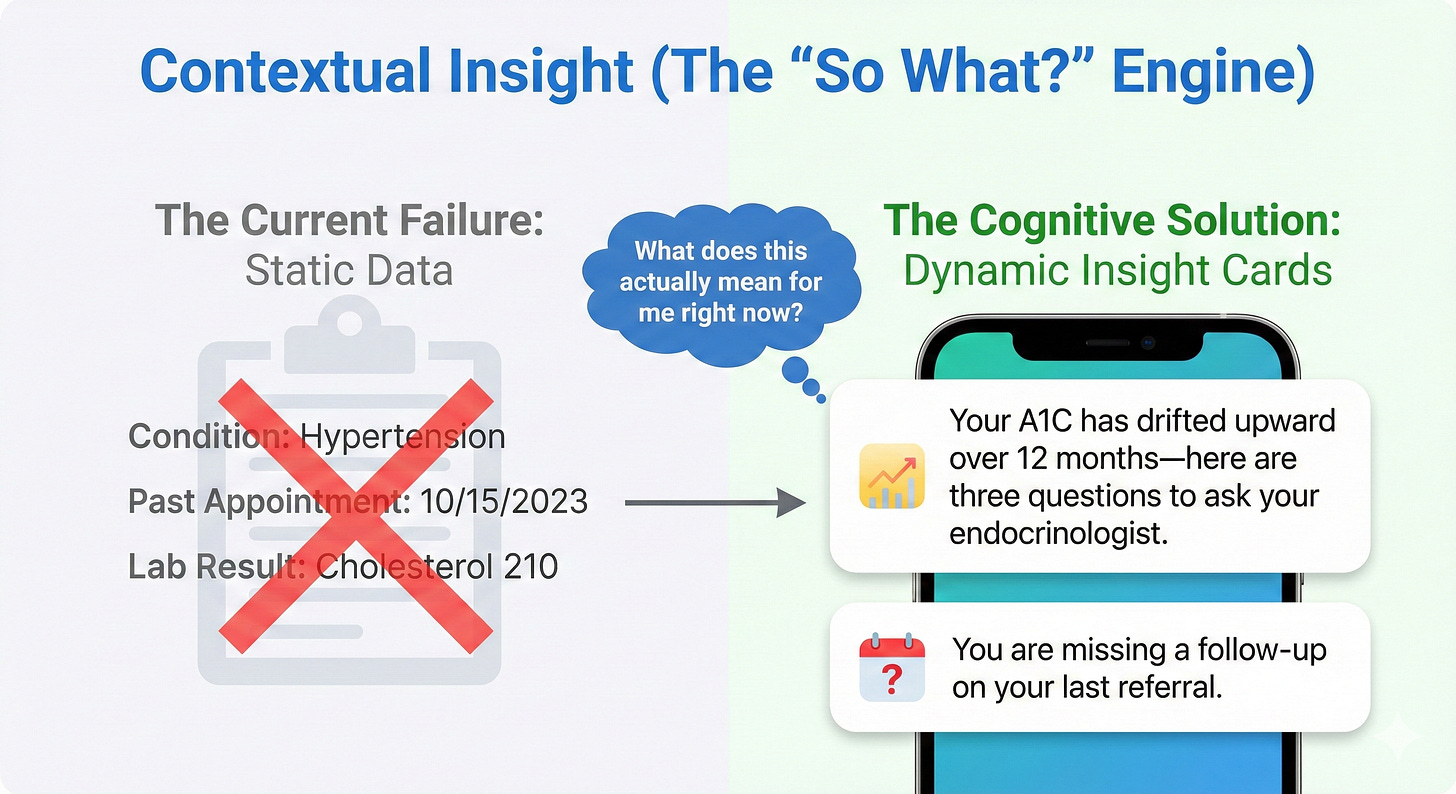
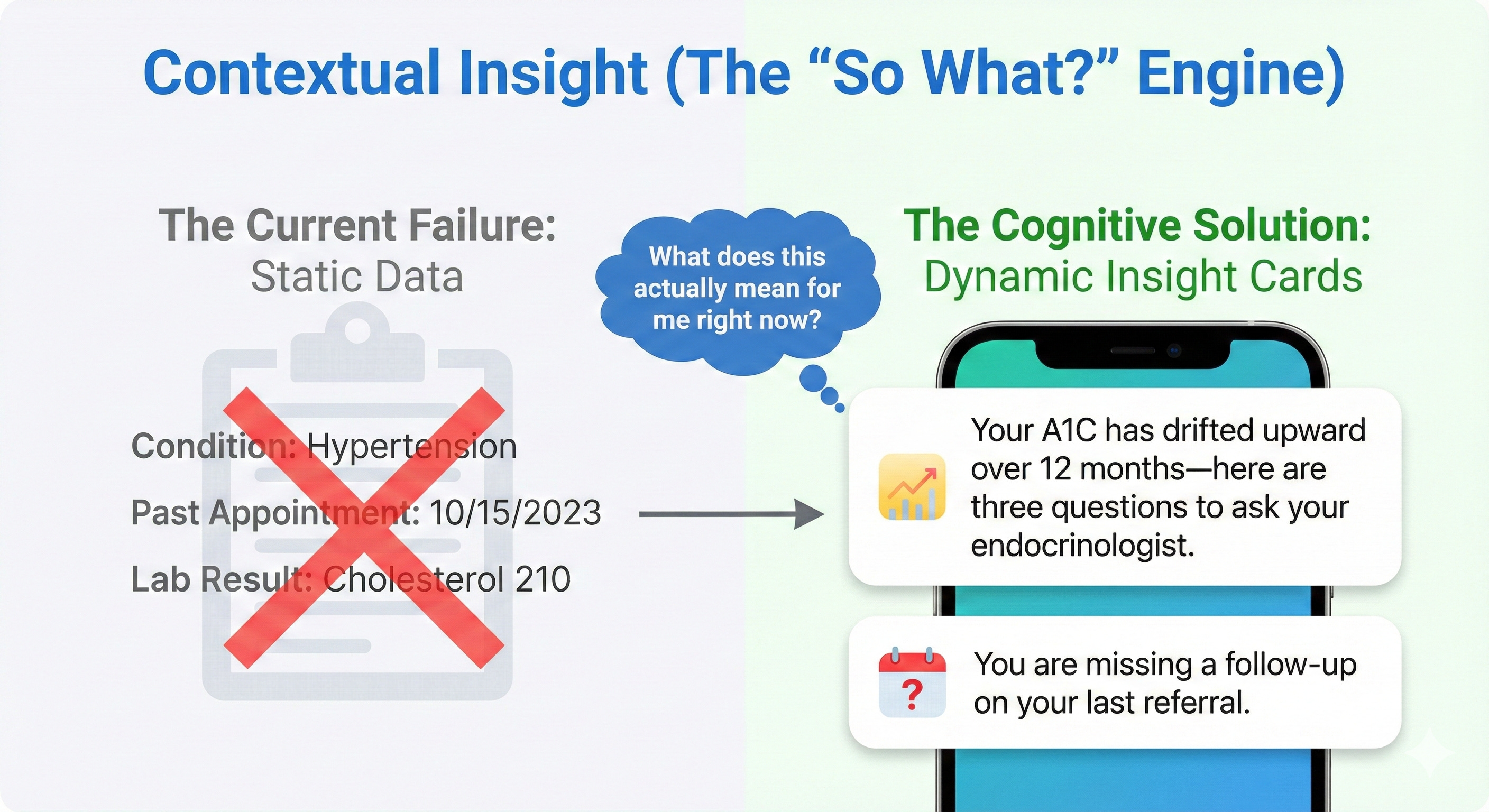
This mirrors the cognitive support providers get from clinical decision support (CDS) tools, but re-engineered for the layperson. It turns a repository of records into an active monitoring system.
4. Expectation Management (The Navigation Layer)
The Current Failure: The “Black Box” of referrals. A patient leaves an appointment knowing they need a specialist, but having zero visibility into the timeline, preparation, or success criteria. The Cognitive Solution: Predictive mapping.
Consumer marketplaces succeeded by anchoring every transaction to a status and a next step. Healthcare is largely a series of open loops.
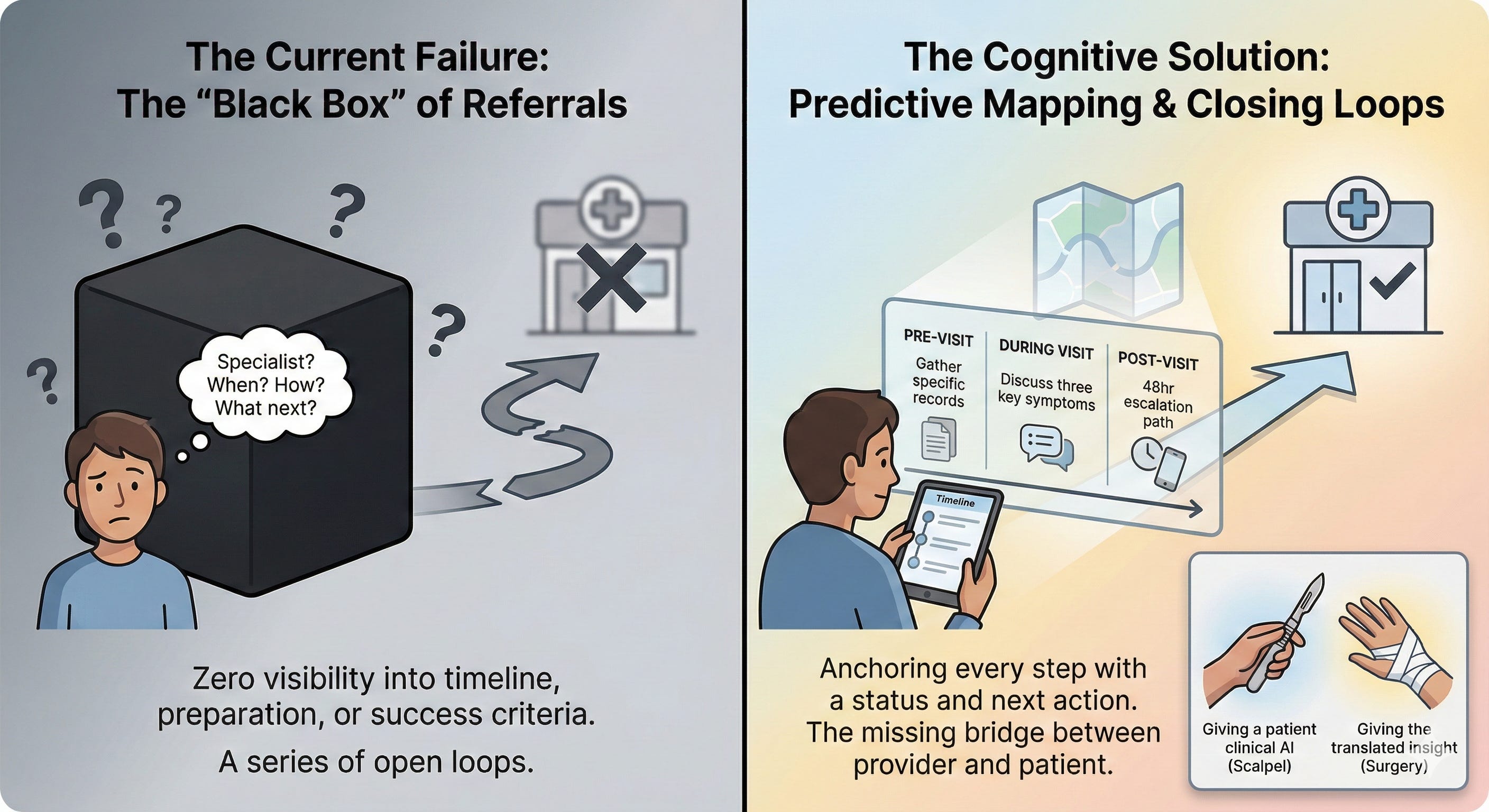
Pre-visit: “Gather these specifically relevant records.”
During visit: “Prepare to discuss these three symptoms.”
Post-visit: “If you don’t hear back in 48 hours, this is the specific escalation path.”
This is the missing bridge between provider cognition and patient reality.
The Industry Mandate
This perspective was crystallized by a recent discussion initiated by Halle Tecco. She posed the question of whether patients should be granted direct access to clinical AI tools like OpenEvidence. The answer isn’t a simple yes or no. Giving a patient a clinical decision engine is like handing them a scalpel; what they actually need is the surgery. They don’t need the raw tool they need the translated insight that the tool provides.
We have spent enough time arguing about FHIR standards and API thresholds. Those are solved problems. The new frontier is interpretation.
If we continue to arm providers with AI-driven synthesis while handing patients raw data, we will widen the health literacy gap to a breaking point.
If you want Patients to be in charge of their health give them the same tools Providers have. (Not ChatGPT for thee, Open Evidence for me).
Check out some prototypes of tools how I imagine tackling these challenges
Patient Narrative Generation
My Health AI Navigator
Check out Halle Tecco and her article on Open Evidence
Thank you for highlighting Halle's post and sharing your proposed ways to tackle these core problems. As a product manager who has worked on Big Tech, Pharma, and for EHR companies, I've remained passionate about health literacy & behavioral change-- what good is all the data if patients aren't empowered to do something with it?
A study published by Microsoft researchers this month found that health queries is the number 1 topic for copilot users on mobile (assuming personal use) and people are seeking advice and guidance, not just basic information. This reinforced a key message for me: If we don't provide medical grade tools for patients soon, they will find their own ways with what's available to them. In an age of misinformation, this is too big of a risk.
Study:
https://microsoft.ai/wp-content/uploads/2025/12/What_people_do_with_Copilot-8.pdf
Frankly, patients are overwhelmed because interoperability was built for billing not educating or enabling care. Patients get formats that check a box for compliance, but patient portals do more to expose the shortcomings of EHRs than they do empower patients or their care teams.