Stop Modeling Medications Like Claims Data: The FHIR Reality Nobody Talks About
Blue Pill or Red Pill

If you want to understand why FHIR is harder than it looks, look at medications.
Everyone loves to talk about Patient, Encounter, or Observation, but the truth is: FHIR Medications are where most implementations fall apart.
Why? Because we’ve been modeling medications the wrong way for decades.

💊 The Historical Trap: Prescription Claims = Medication Truth?
For years, healthcare relied almost exclusively on claims data to represent medications. That worked fine when the only question was: “Did the payer cover a prescription?”
But claims ≠ clinical truth.
Claims tell you what was prescribed and paid for.
They don’t tell you if the patient actually took the drug.
They don’t capture over-the-counter meds, samples, or discontinued therapies.
In FHIR, this gap is no longer acceptable. FHIR forces us to think about medications in their full lifecycle: prescribed, dispensed, administered, and actually taken (or not).
That’s the paradigm shift that terrifies implementers.

⚡ Why FHIR Medications Are So Complex
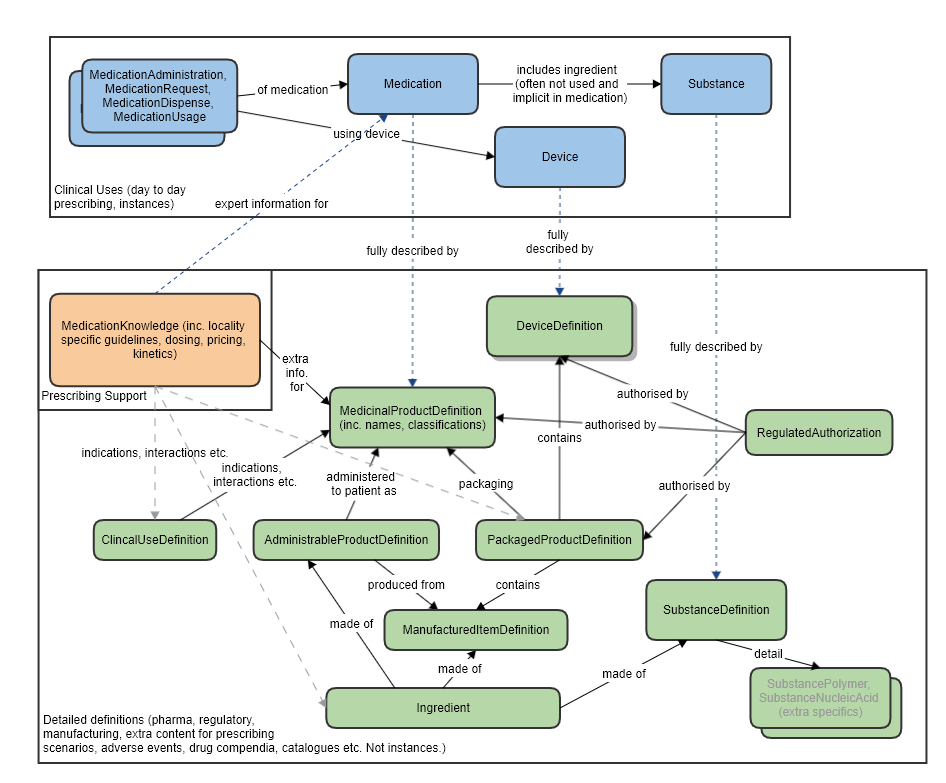
Here’s the kicker: FHIR doesn’t give you just one way to represent medications. It gives you five (at least).
FHIR R4 (the spec most people use):
MedicationRequest → a prescription written by a provider.
MedicationDispense → what the pharmacy actually gave.
MedicationAdministration → what was actually administered (mostly inpatient).
MedicationStatement → what the patient says they’re taking.
Medication → the description of the drug itself.
And that’s before you add List (medication lists), Composition (summaries), and terminology bindings like RxNorm or NDCs.
Most developers stare at this web of resources and think: “Which one am I supposed to use?” The uncomfortable truth is: you need them all if you want accuracy.
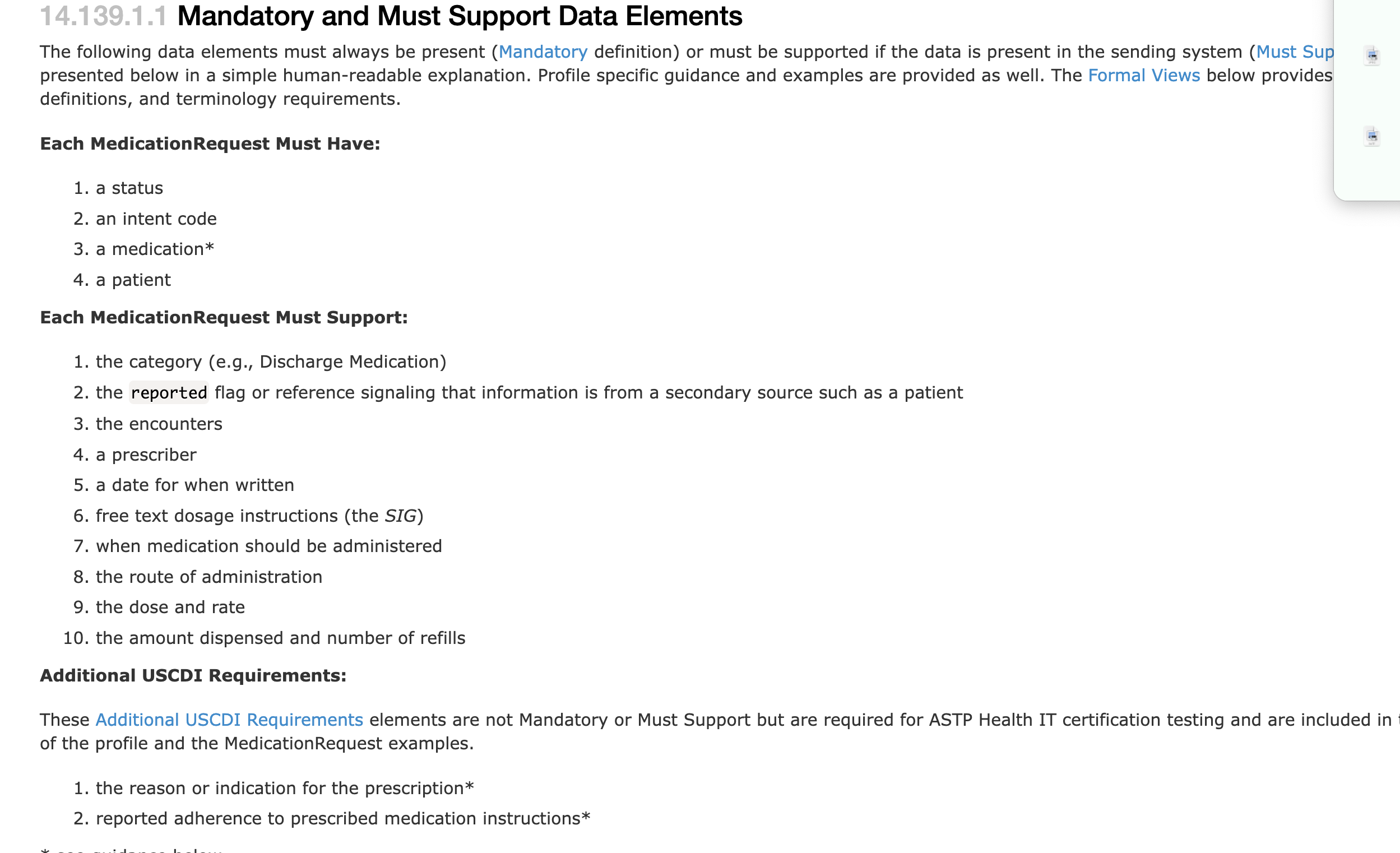
US Core Medication Request Profile
How to create a US Core based Medication List
🔮 R5: What’s Changing and Why It Matters
FHIR R5 isn’t widely implemented yet but it’s coming.
It tightens definitions around MedicationStatement vs. MedicationUsage (a rename).
It aligns terminology more consistently across US, NHS, and EU.
It pushes implementers to stop using MedicationRequest as a catch-all.
Translation: if your platform is still hard-coding everything into MedicationRequest today, you’re racking up technical debt.

🌍 Global Reality Check: US vs UK vs EU
One reason medications are so messy in FHIR? Different regions model them differently:
US Core IG → tight RxNorm alignment, payer-driven needs (Star Ratings, HEDIS).
NHS IG (UK) → stronger focus on administration + reconciliation at point of care.
European IGs → broader focus on safety, cross-border polypharmacy, terminology diversity.
If you’re building global-ready FHIR solutions, ignoring these differences is a business killer.
📊 Real Use Cases That Break If You Don’t Get This Right
Medication Adherence → Knowing if the patient is actually taking the drug, not just if it was prescribed.
Medication Reconciliation → Comparing “what was prescribed” vs “what’s reported” vs “what’s in the EHR” (often three different answers).
Polypharmacy Management → Safe prescribing when a patient has 12+ meds on their profile.
Quality Measures (HEDIS / Star Ratings) → If you don’t model medications correctly, you’ll miscalculate adherence and cost yourself revenue.
🧨 The Contrarian Take: FHIR Didn’t Make Medications Hard. It Exposed How Broken They Already Were.
Everyone blames FHIR for being “too complicated” when it comes to medications. The truth is harsher:
Medications have always been fragmented across claims, pharmacy, EHR, and patient self-report.
FHIR didn’t create the messit just forced us to look at it head-on.
That’s why so many implementers fail here. They keep trying to jam old claim-centric thinking into a FHIR model designed for clinical reality.
If you want to win in this space whether you’re a payer, provider, or health tech vendor you need to stop asking “Which resource should we use?” and start asking:
👉 “Which part of the medication lifecycle do we actually want to represent?”
That’s the real strategy shift.
🔑 Key Takeaways
Safe implementations = wrong implementations. Stop modeling meds only off claims.
FHIR requires lifecycle thinking. Prescribed ≠ dispensed ≠ administered ≠ taken.
R5 is a warning shot. MedicationRequest catch-alls won’t survive.
Global IG differences matter. Don’t build a US-only solution if you want scale.
Quality and revenue depend on this. Mis-modeling medications leads directly to measure failures and financial loss.

Measures That Live and Die by Medication Data
HEDIS (NCQA)
Key measures that rely on accurate medication modeling include:
Statin Therapy for Patients With Cardiovascular Disease (SPC) and Statin Therapy for Patients With Diabetes (SPD) — both require precise pharmacy dispensing data to assess whether patients are on their statins UHC Provider.
Use of High‑Risk Medications in Older Adults (DAE)—NCQA is reworking drug classes to align with updated Beers Criteria, making medication mapping even more critical Hopkins Medicine+1.
Changes for HEDIS 2026:
NCQA has revamped technical specifications to align with FHIR/ECDS standards, signaling a move toward FHIR-native reporting eCQI Resource Center+15NCQA+15Cotiviti+15.
They’ve also retired measures like the Asthma Medication Ratio (AMR), replacing it with a follow-up after urgent asthma care visit measure—meaning medication-based logic has shifted Cotiviti+1.
eCQMs (CMS / ECQI)
eCQMs that involve medication adherence, reconciliation, or management are evolving. CMS continues refining logic through its eCQM guidance, though no specific 2026 eCQM with medication focus has been finalized yet NCQA+7eCQI Resource Center+7Medisolv Blog+7.
Star Ratings (CMS Medicare Advantage / Part D)
Part D Medication Adherence measures (e.g., for statins, RAS inhibitors) are aligning to PQA specifications; CMS has also removed the 60% rule and is phasing in risk adjustment by 2028 Cotiviti+2Lilac Software+2.
This tightens the need for accurate medication timelines, dosages, and refill patterns meaning you can’t fudge the data.
What Data Elements Now Drive Real Dollars
If you think medication modeling is just academic think again. Here's what actually matters for quality and revenue:
RxNorm / NDC codes to match medications to measure definitions.
Dispense dates and quantities, number of days supplied for adherence ratio calculations.
MedicationRequest vs. Dispense vs. Administration vs. Statement — you need clarity on where you’re drawing data for each measure.
Timeliness of PDE (Prescription Drug Event) data CMS now mandates initial PDE submission within 30 days (for selected drugs, just 7 days) and any corrections or deletions within 90 days federalregister.gov.

Validating RxNorm and NDC: Where Everyone Trips Up
If you’re working with medications in FHIR, you can’t ignore terminology validation. Most failed implementations come down to sloppy handling of RxNorm and NDC codes. Here’s what you need to know:
1. Understand the Core Difference First
RxNorm → A clinical concept. Normalized clinical drug names, dose forms, and ingredients. Used in EHRs, decision support, and clinical quality measures.
NDC → A retail concept. Identifies the package-level, branded or generic drug as dispensed by pharmacies. Used heavily in claims, billing, and retail supply chain.
👉 Mistake: Teams treat RxNorm and NDC as interchangeable. They’re not. RxNorm is for what the provider intended clinically. NDC is for what the patient actually picked up at CVS.
2. Use Terminology Services, Not Hardcoding
NLM RxNorm API / RxNav — Official daily updates; validates, normalizes, and maps between NDC ↔ RxNorm.
NLM VSAC (Value Set Authority Center) — Official source of value sets tied to CMS/NCQA quality measures.
NCQA HEDIS Value Sets — Updated annually, increasingly aligned to FHIR ECDS specs. These often include specific RxNorm ingredient codes (IN) or clinical drug codes (SCD/SBD).
👉 Mistake: Many organizations hardcode local drug lists or value sets. Within months, they’re stale. Terminology changes constantly (new NDCs, retired codes, restructured drug classes).
3. Commercial Terminology Services Add Muscle
Vendors like IMO Health, Medibank, Wolters Kluwer, First Databank provide:
Normalized mappings across RxNorm, NDC, SNOMED, LOINC.
FHIR Terminology Services endpoints (often enterprise-grade, with uptime SLAs).
Continuous maintenance + alignment with quality programs.
👉 Tradeoff: They cost money, but save you from firefighting bad mappings when your Star Ratings or HEDIS scores are on the line.
4. Validation Isn’t Just Code Matching
Good validation means checking:
Code exists (not retired or deprecated).
Code aligns to correct semantic level (ingredient vs branded drug vs package).
Code is still active in value sets used for quality measures.
Mapping directionality NDC ↔ RxNorm is many-to-one or one-to-many. You must decide which clinical level to normalize to.
5. What to Keep in Mind for Measures
HEDIS / Star Ratings → Usually look for RxNorm Ingredient or Clinical Drug codes (statins, RAS inhibitors, diabetes meds). If you’re passing NDCs directly, you’ll fail unless you normalize.
eCQMs → Often reference VSAC value sets built on RxNorm. Sync your terminology pipeline with VSAC refresh schedules.
Real-World Adherence → You’ll need both. RxNorm for clinical alignment, NDC for retail fill patterns.

That is a gold mine for AI researchers and developers.