Methodology in public: what "85% endpoint reachability" actually counts
Two questions from a sharp reader, two clarifications worth publishing

Two days after the 2026-06-02 release, a smart and knowledgeable reader sent two questions about the AINPI methodology. Both worth publishing because the whole point of an open audit substrate is that smart readers catch what you missed.
Question 1: what is the denominator on endpoint reachability?
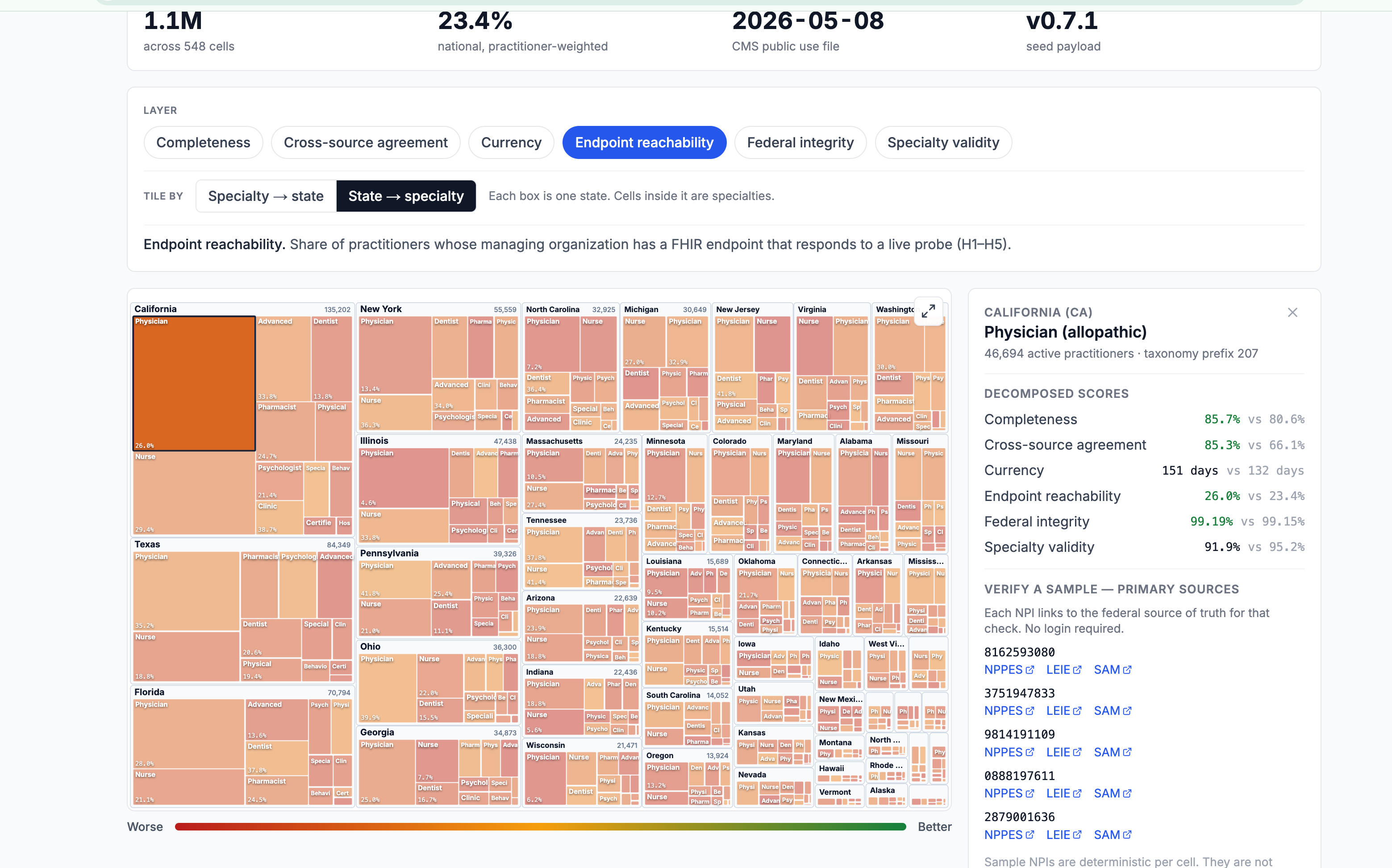
The finding page reports: “85.4% of FHIR-REST endpoints answer with a parseable CapabilityStatement.” The natural reading is “85% of practitioners are reachable.” That reading is wrong, and it materially overstates patient access.
The actual chain:
5,043,524 Endpoint resources in the 2026-04-09 NDH release
Filter to FHIR-REST connection type
Dedupe to unique hostnames (many endpoint records share a base URL)
Result: 2,974 distinct FHIR-REST hosts
85.4% of those serve a parseable CapabilityStatement
Practitioner-level reachability is dramatically lower because 98.7% of organizations in the federal directory carry zero Endpoint references at all. Even when a host is alive, only a small share of practitioners hang off it via the practitioner → role → managing_org → endpoint chain.
The methodology page is being updated to make the host-level vs practitioner-level distinction explicit. The numbers don’t change; the framing does. “85% of hosts” is the right reading. “85% of practitioners” is not the methodology’s claim and would be a different (much lower) number
.
Question 2: are you pinging endpoints through Claude, or a script?
A real script a standalone Python crawler at github.com/FHIR-IQ/ainpi-probe, deliberately separated from the site repo so operators can audit (or whitelist) just the probe code without inspecting the whole platform. Named User-Agent. Stable IP ranges via GitHub Actions. Accept header advertising FHIR JSON.
But the underlying question anti-bot filtering is broader than AINPI. Everyone doing FHIR audit work hits it now. Three flavors of block, three different fixes:
TLS fingerprint blocking (Akamai, Cloudflare): plain Python
urllibandhttpxget 403’d even with valid headers. Shelling out tocurlvia subprocess works because curl uses the system TLS stack and gets fingerprinted as a real client.User-Agent blocking: stable named UA plus a published allowlist path so ops teams can whitelist intentionally.
Vendor-specific agent blocking: some EHR and payer systems explicitly block calls originating from LLM agents (Claude, GPT, etc.) regardless of UA. Different fix requires a fixed egress IP allowlisted in advance.
The implication nobody is talking about
If directory accuracy is going to be measured at scale by 2029 as HR 7148 § 6220 will require regulators and plans will hit the same walls. The audit methodology has to be public enough that vendors can choose to allowlist it without it being either security-by-obscurity or vendor-by-vendor manual coordination.
That’s an unsolved problem worth flagging upstream of the 2028 CMS scoring RFC. There isn’t a great answer yet. But “we built a directory accuracy framework that gets WAF-blocked by the directories it audits” is the kind of thing that gets discovered the hard way at procurement time. Better to surface it now.
The broader point
The open audit substrate premise only works if smart readers actually push back. This is the loop working within 48 hours of the release, a sharp reader caught two things worth clarifying. Both clarifications are on the methodology page now.
If you spot something else that needs sharpening, the substack reply or email reply both reach me directly.
— Eugene Vestel, FHIR IQ
→ Updated finding: ainpi.dev/findings/endpoint-liveness
→ Probe repo: github.com/FHIR-IQ/ainpi-probe
→ Policy brief: ainpi.dev/real-health-providers
Discussion about this post