HTI-5 Is a Cleanup. The Real Rule-making Is Happening in Verona.
ONC removed 14 certification criteria. Epic shipped MCP connectors the same month. Only one of these will shape the next five years of health IT.

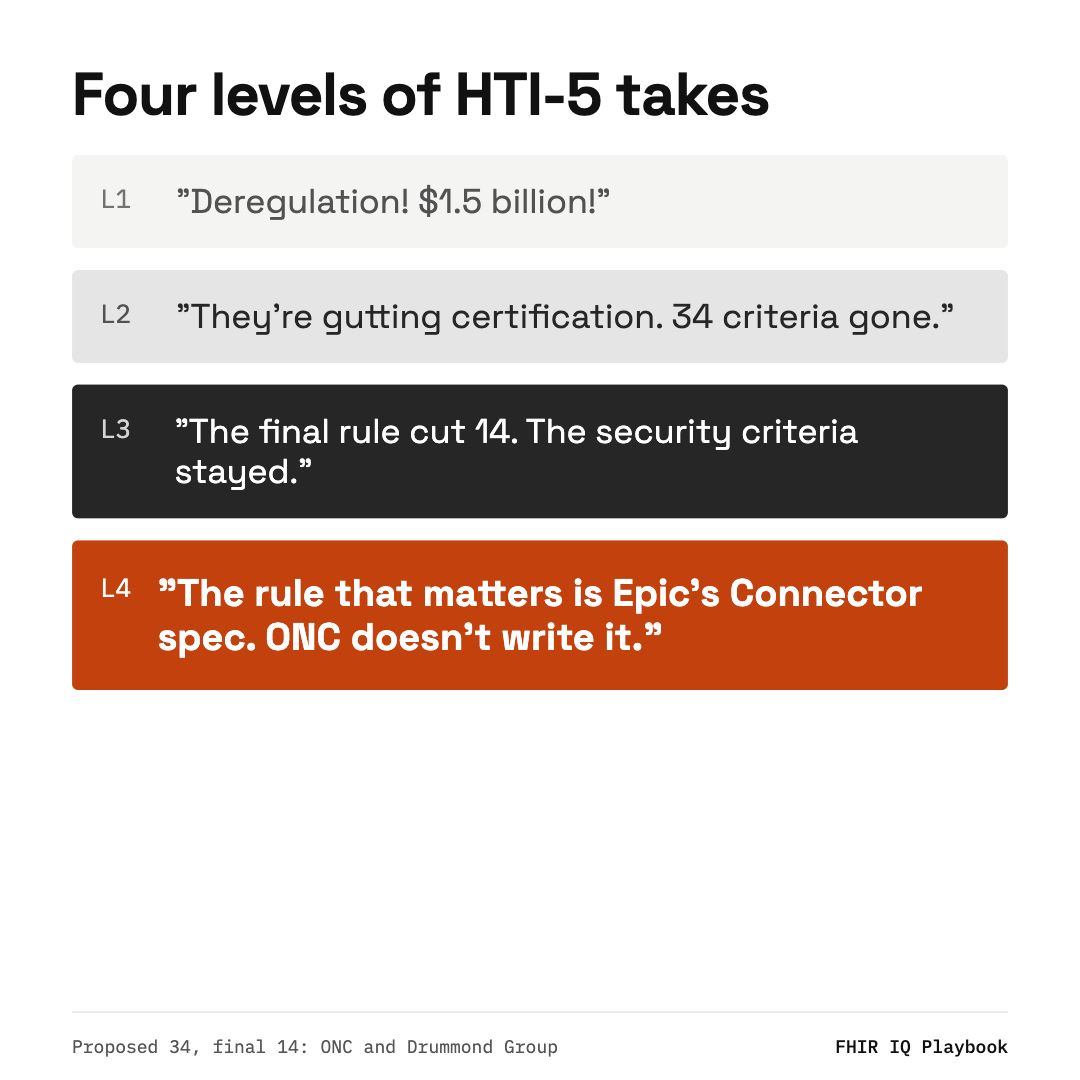
ONC finalized HTI-5 on October 26. HHS projects more than $1.5 billion in reduced regulatory costs and frames the rule as freeing developers to build better tools. Read the criteria table instead of the press release and a smaller story emerges. The rule is a cleanup. The decisions that will shape AI in the EHR are either deferred to future rulemaking or being made by vendors, outside the regulatory process.
What HTI-5 actually did
The certification program had 60 criteria. The final rule removes 14, revises 7, and leaves 39 unchanged, including the HTI-4 electronic prior authorization API criteria.
The proposed rule went much further. It would have removed 34. The final version kept the privacy and security criteria the proposal targeted, including multi-factor authentication, audit reports, and encrypted authentication credentials. Safety-enhanced design moved from removal to revision. Patient safety and security advocates pushed hard on those criteria during comment, and ONC pulled back.
What went:
Legacy clinical decision support, § 170.315(a)(9), already sunset by HTI-1 in favor of decision support interventions (DSI)
Direct Project and Direct Edge Protocol, (h)(1) and (h)(2)
Care plan, family health history, and patient health information capture
C-CDA creation performance and the security tags criteria
Automated numerator recording and automated measure calculation
Application access for patient selection and all data request, (g)(7) and (g)(9), effective January 1, 2027
The last pair is the most telling removal. Those are older API criteria that predate the standardized FHIR API at (g)(10). With them gone, the FHIR API is the API in the program. ONC says the rule resets the program’s scope to create a foundation for future FHIR-based API requirements that support AI-enabled interoperability.
Two items deserve a closer read. DSI, (b)(11), was revised. The proposal would have trimmed the source-attribute transparency requirements that HTI-1 introduced for predictive and AI-based tools, so read the final regulatory text before assuming what survived. And ONC scaled back Real World Testing and Insights reporting, but kept the FHIR bulk data access measure. That is a signal about what ONC still wants to see.
Why this is not a big deal
The removed criteria were not where anyone made money or built products. Vendors will stop testing these capabilities for certification. Most will not rip them out, because customers still run transitions of care on C-CDA and Direct. Transitions of care, (b)(1), was revised with an effective date of January 1, 2030. Document-based exchange will be around for a while.
The savings accrue to developer compliance teams. HHS’s own framing is that developers can redirect those resources toward user experience. Whether they do is a product decision. Large EHR vendors will spend freed budget where their roadmaps already point, and in 2026 every roadmap points at agents.
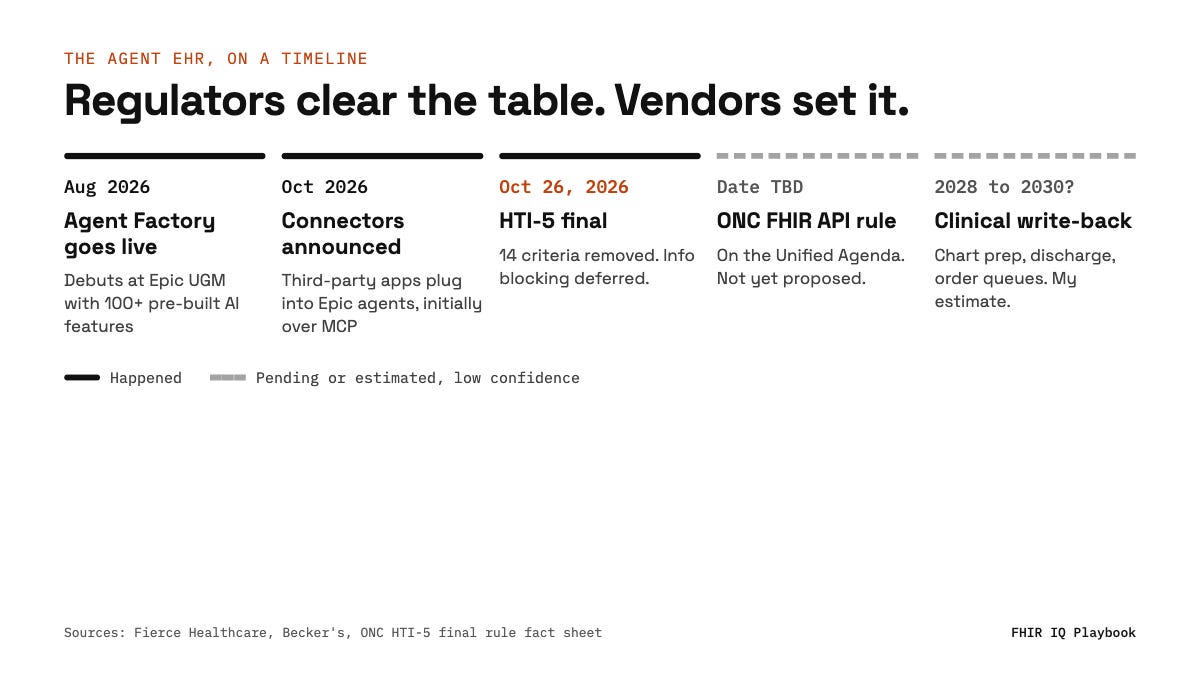
The consequential pieces are not in this rule. ONC says comments on the information blocking proposals remain under consideration. The expanded FHIR API requirements are a future proposal listed on the Unified Agenda. HTI-5 clears the table. The next rule sets it.
FHIR in the age of agents
A common argument goes like this: large language models read unstructured text, so structured standards matter less. That gets the direction wrong.
Reading is the easy part. An agent that places an order, files a prior authorization, or reconciles a medication list has to write structured data back into a system of record. A write needs a schema, an authorization scope, and an audit trail. SMART on FHIR and US Core already provide all three, and they are the only cross-vendor contract that does.
MCP does not replace FHIR. MCP is how an agent discovers and invokes a tool. FHIR is what the tool reads and writes. Most healthcare MCP servers in circulation today are thin wrappers over FHIR endpoints, and that is the right design. The protocol layer and the data contract solve different problems.
The gap FHIR has not closed is data quality. A resource can conform to a US Core profile and still carry a wrong address, a stale medication, or a provider who left the practice two years ago. Agents amplify that problem. A human scanning a chart applies judgment to bad data. An agent acting at volume propagates it. Conformance testing will not catch this. Data quality measurement at the source will and governance programs at the source is how you fix this.
Why Epic is moving fast on Connectors and MCP
The timeline is quick. Epic previewed Agent Factory at HIMSS in March 2026, a no-code builder for health systems to create agents that reason and act across workflows. It debuted at the User Group Meeting in August with more than 100 pre-built AI features. Advocate Health reportedly had Agent Factory workflows in production for inpatient pharmacy and infusion chart preparation by July. Last week, ahead of Open@Epic, Epic announced Connectors: a way for third-party apps to plug into Emmie, Art, Penny, and custom Factory agents. Epic says it will initially use MCP as the standard for building them.
My read on why Epic is moving this fast:
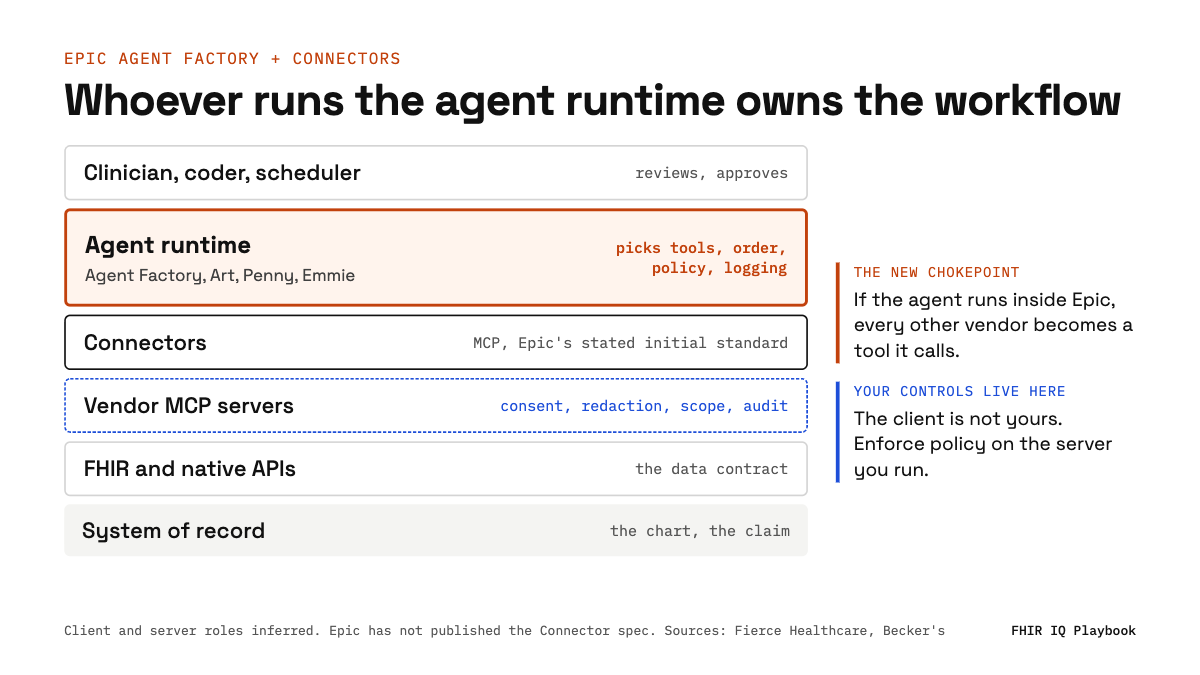
The orchestration layer is the new chokepoint. Whoever runs the agent runtime decides which tools get called, in what order, under what policy, and with what logging. If a health system’s agents run inside Agent Factory, third-party vendors become tools. Their user interface disappears into Epic’s. Their access is mediated by Epic’s client. This is App Orchard logic applied to agents. Epic has not published the Connector specification, so the exact client and server roles are an inference, but the commercial shape is clear.
The alternative is becoming a database. Health systems and developers are already wiring general-purpose AI assistants to Epic through FHIR. If the agent lives outside Epic, Epic is the system of record and someone else owns the workflow. Agent Factory keeps Epic as the surface where work happens.
MCP is cheap to adopt and hard to criticize. It is an open standard with broad tooling. Adopting it lets Epic say it is open while keeping the runtime closed. Epic reported 26 million records exchanged daily at Open@Epic, more than half with non-Epic systems, and over 3,000 live apps. Connectors extend that position into agents.
For vendors, the implication is direct. If you sell into Epic shops, you will ship an MCP server, and the client calling it will belong to Epic. Your differentiation moves to the quality of the tool and the controls around it. Consent, redaction, scope checks, and audit have to live on the server you control, because the client is not yours.
Disclosure: I build HealthClaw Guardrails, an open-source project that enforces those controls server-side for FHIR MCP servers. Weigh this section accordingly.
Agents will take billing and admin work first
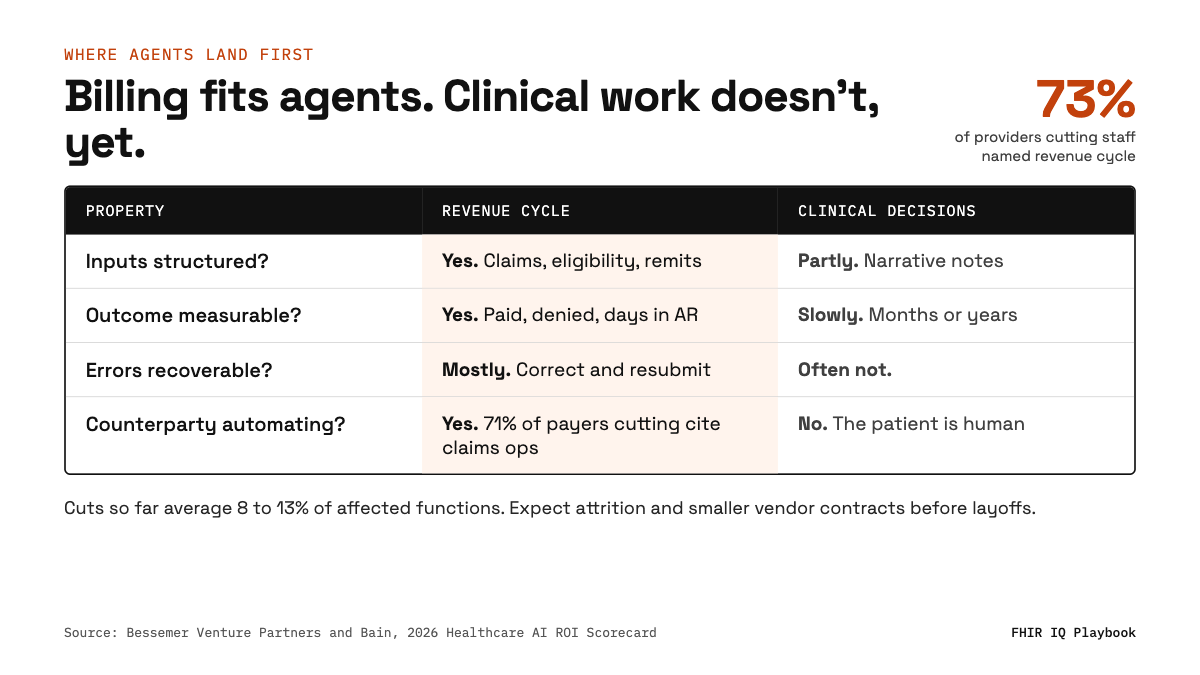
The back office goes first, and the early data supports it. The 2026 Healthcare AI ROI Scorecard from Bessemer Venture Partners and Bain reports that half of surveyed organizations have reduced headcount because of AI or plan to within six months, with targeted reductions averaging 8 to 13 percent of affected functions. Among providers reporting cuts, 73 percent named revenue cycle and billing. Provider revenue cycle posted the highest return in the study, 4.0 times cost, with 67 percent of solutions running as semi- or fully autonomous agents.
Revenue cycle fits agents for structural reasons. Inputs are already structured transactions. Outcomes are measurable: paid, denied, days in accounts receivable. Most errors are recoverable, since a claim can be corrected and resubmitted. And the counterparty is automating too; 71 percent of payers reporting cuts named claims operations. Clinical work has none of those properties.
“Replace” needs calibration. Practice-level surveys still describe gradual redesign: AI agents on the phones, departing staff not backfilled, outsourced work brought back under automation. Among practices using AI in visits, 39 percent reported reduced staff workload and 44 percent did not. Expect headcount to fall through attrition and vendor contracts before it falls through layoffs. The direction is not in doubt. The pace is.
What AI scribes already showed us
Ambient scribes are the first large-scale deployment of generative AI in clinical workflow, and they are the best evidence we have for how agents will land. The results are more modest than the marketing.
UCLA randomized trial, NEJM AI, 238 physicians. Nabla users saw a 9.5 percent reduction in time-in-note against control. Microsoft DAX users showed no significant change. Burnout and task load scores improved for both.
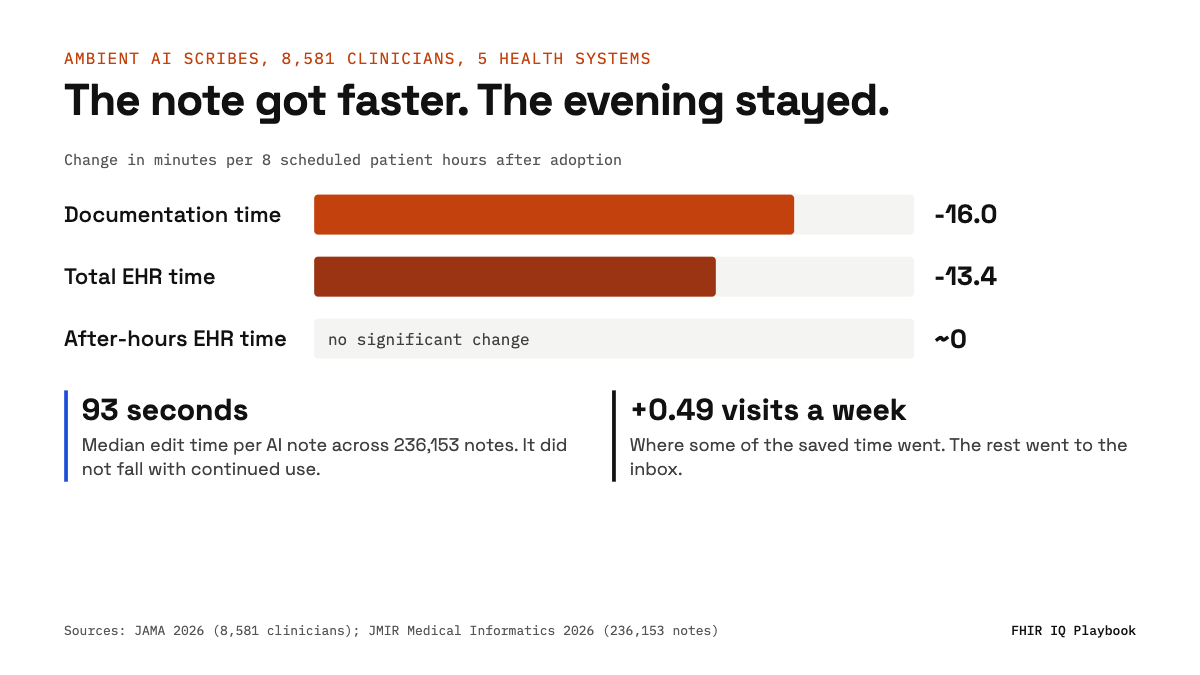
JAMA, 8,581 ambulatory clinicians across five health systems. Adoption was associated with about 13 fewer minutes of total EHR time and 16 fewer minutes of documentation per eight scheduled patient hours, roughly 3 and 10 percent relative reductions, plus about half an additional visit per week. After-hours EHR time did not change significantly.
Retrospective cohort, JAMA Network Open. Median time in notes fell by about half a minute per appointment. After-hours documentation time did not change.
JMIR Medical Informatics, 236,153 notes. Median editing time per note was 93 seconds, and it did not decrease with continued use.
The pattern: scribes save some time, the saved minutes get absorbed by the inbox and added visits, and the evening work stays. The job shifted from writing notes to reviewing them. Review has a cost, and in the largest editing dataset that cost did not shrink with familiarity.
Burnout improved more than time did. That suggests the cognitive load of composing a note matters more to clinicians than the minutes. It is a real benefit. It is a different benefit from the one sold.
The lesson for agents is that a system which drafts and a human who signs does not remove the human’s time. It converts the job into verification. Back-office agents will show larger gains than scribes because they can close loops without a human signature on every item. Clinical agents will hit the scribe ceiling until there is a governance model for which actions can complete without review.
When EHR innovation will actually show up
This section is my judgment, and the dates are low confidence.
It will not come from certification. It needs three conditions:
An agent runtime with governed write access. Epic now has one. Oracle Health and others will follow.
A cross-vendor FHIR floor that includes writes. That is the next ONC API rule, which does not exist yet.
Payment that rewards removed work. Today a health system pays for drafts and visit volume, so that is what vendors optimize.
I expect visible change in the back office through 2027, and clinical workflow change in chart preparation, discharge, transfers, and order queues after write-back governance matures, likely 2028 to 2030. When it arrives it will not look like a new EHR. It will look like the same Epic screen with fewer clicks and a queue of proposed actions waiting for approval. The tradeoff is concentration. If most clinical agents run inside one vendor’s runtime, much of the next decade’s innovation happens inside that vendor, and startups compete as tools.
What to do with this
Vendors: ship an MCP server over your FHIR or native API now. Put consent, redaction, scope enforcement, and audit on the server.
Health systems: measure agents on work removed end to end, including review time, inbox time, and after-hours time. The scribe studies show why output counts mislead.
Policy watchers: read the final DSI text in HTI-5, then track the information blocking decisions and the FHIR API proposal. That is where the regulatory action is.
Sources
Drummond Group: How the HTI-5 Proposed Rule Affects Certification
HIT Consultant: Bain and Bessemer 2026 Healthcare AI ROI Scorecard
HealthManagement.org: AI reshapes practice workflows without wide job cuts
Use of an AI Scribe and EHR Efficiency (retrospective cohort)
JMIR Medical Informatics: Evaluation of an AI Medical Scribe After 236,153 Notes
Reading the criteria table instead of the press release is the useful habit here. Removing 14 of 60 criteria and keeping the security ones is a much smaller story than the $1.5 billion headline suggests.