HL7 FHIR DevDays 2026: A Conference Where Everyone's Building Something Not Selling you anything
The one healthcare conference where nobody’s selling you anything and everybody’s building something real.


There’s a particular feeling at HL7 FHIR DevDays that I haven’t found anywhere else in healthcare. Nobody’s working an angle. There’s no booth choreography, no “let’s grab thirty minutes” that’s really a sales call in disguise. Everyone in the room is building something, trying to learn something, or trying to connect with someone who’s solving a problem they care about. That’s it. That’s the whole conference.
It’s the opposite of the HIMSS or HLTH machine, where the agenda is set before anyone walks in and the conversations are mostly transactions. DevDays is builders showing other builders what they made, warts and all. I left Minneapolis with a notebook full of things I want to go try, which is the only metric for a developer conference that actually matters.
Here’s what stuck with me.
SQL on FHIR: the analytics layer is finally arriving
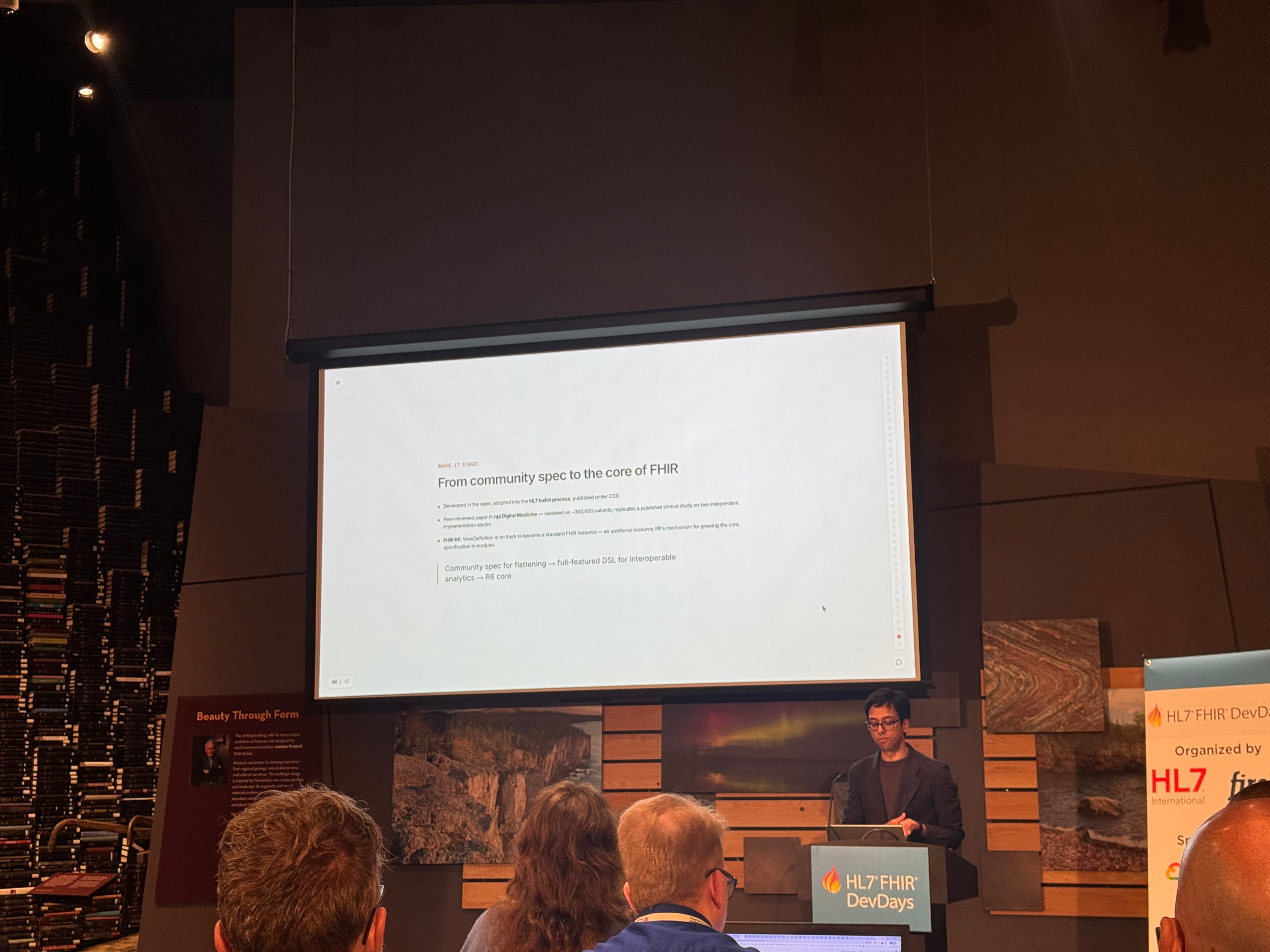
If there was a center of gravity this year, it was SQL on FHIR. The community has spent years on the problem of getting usable, queryable data out of FHIR’s nested JSON, and 2026 felt like the year it clicked into place.
Brendan Kowitz’s “Flattening the Curve: Implementing the SQL on FHIR ViewDefinition” showed real, working progress on ViewDefinitions — the spec that lets you define flat, tabular views over FHIR resources. This is the unglamorous plumbing that makes every downstream analytics use case possible, and seeing it actually implemented was a highlight.
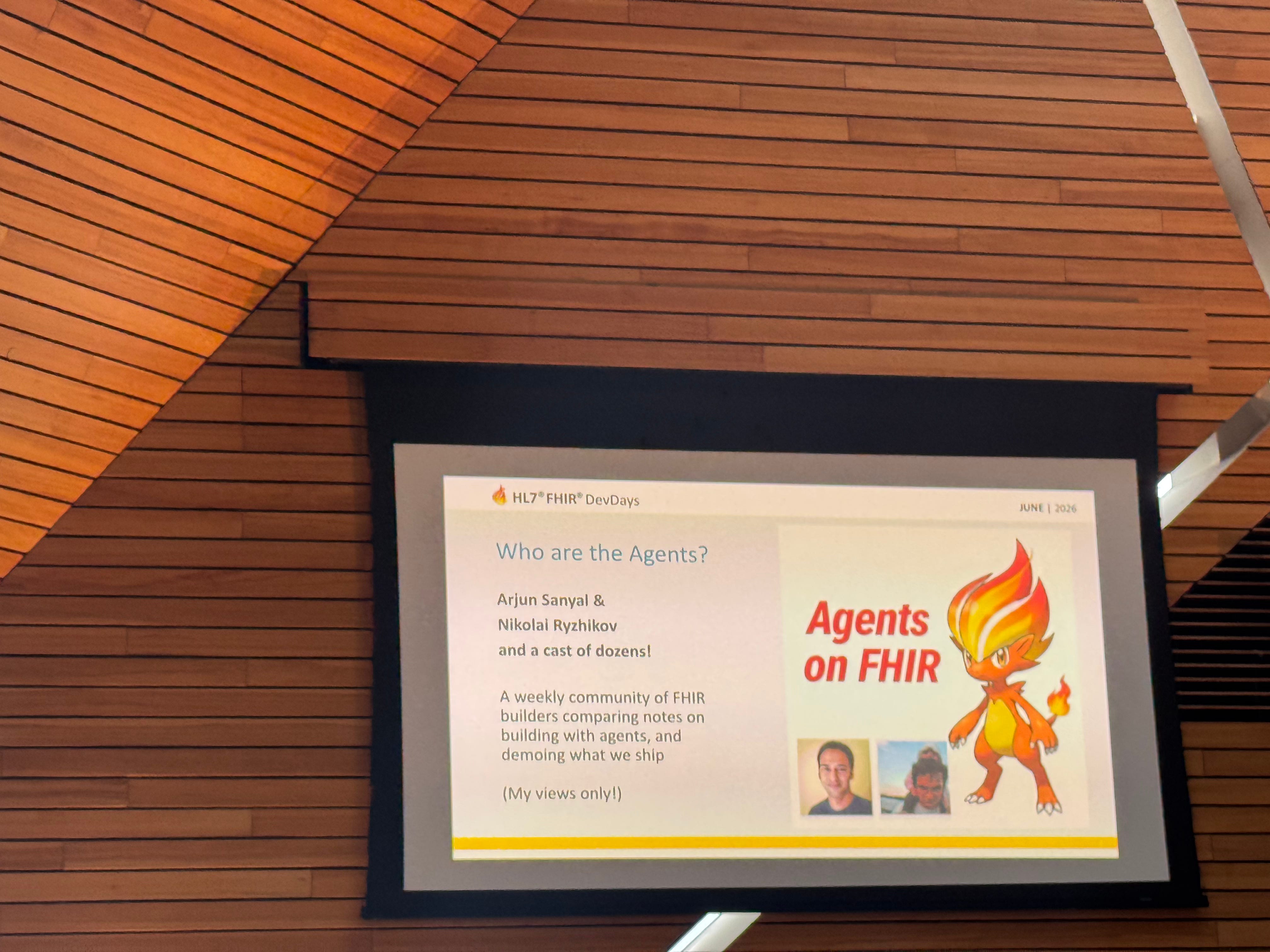
Nikolai Ryzhikov and Arjun Sanyal’s “SQL on FHIR: 2026 Report” gave the state of the union, including impressive progress on the query library object. And Arjun’s second talk, “SQL on FHIR Analytics and Agentic Workflows”, did something I find genuinely important: it connected the analytics and data-platform world’s actual needs back to the FHIR community’s standards work. Those two communities don’t always talk to each other, and Arjun is one of the people bridging them. (He also, generously, put HealthClaw up on his slides the kind of thing that happens at DevDays and nowhere else.)
CQL: theory meeting practice
The Clinical Quality Language track had some of the most intellectually satisfying work of the conference.
Evan Machusak’s “Deterministic CQL-to-SQL in .NET” was a standout. The work of aligning CQL to relational algebra and SQL theory making the whole thing fit together programmatically and deterministically is the kind of rigorous foundation that pays off for years. There’s an implementation guide and working group coming, and I’ll be watching it closely.
(Note: Check out my talk with @Evan here )
Preston Lee’s “CQL Studio: Lessons from Building a FHIR-Native CQL Development Experience” was both a great talk and a personal one for me Preston and I are collaborating to add a CQL-to-SQL proof of concept into CQL Studio. Watching someone build real developer tooling for CQL, and getting to be part of where it goes next, is exactly the collaborative energy this conference runs on.
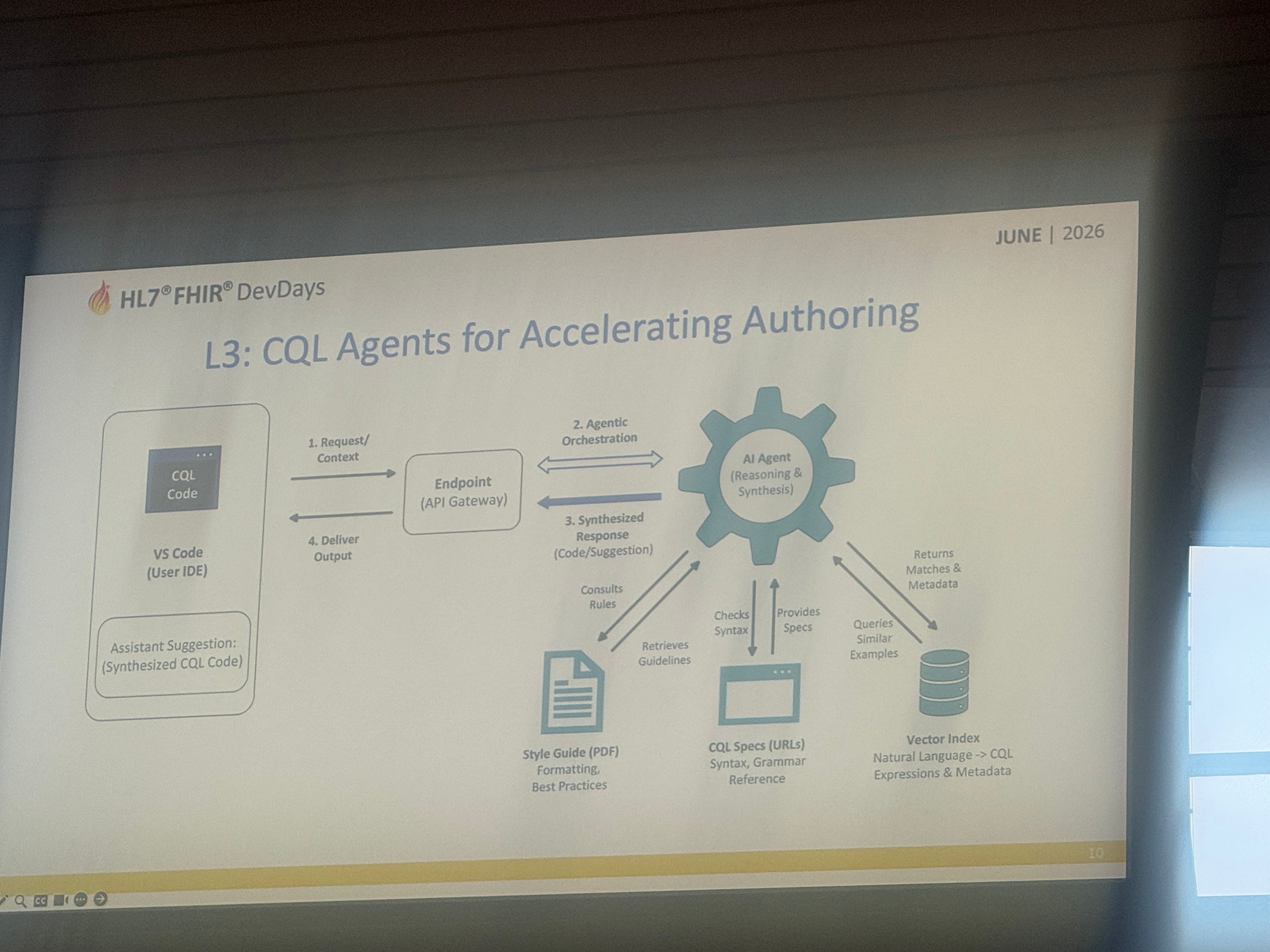
And Evan showed up again in “Agentic Knowledge Development” with Jeff Danford (Optum), pushing on how agents and clinical knowledge authoring come together.
The FHIR Community Process and the tooling around it
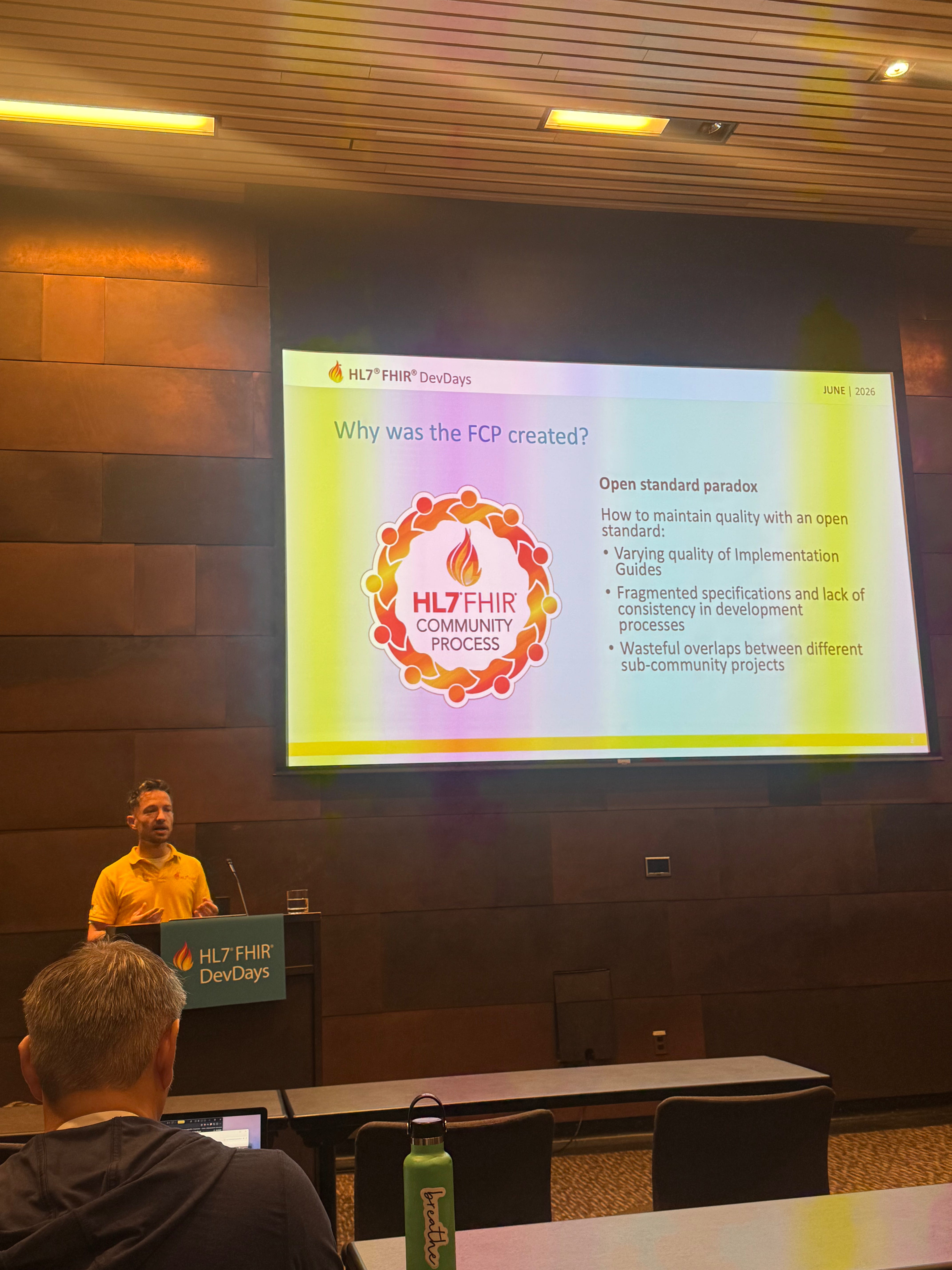
Ward Weistra’s “Implementing the FHIR Community Process” showed amazing progress on Simplifier, including a new demo of an AI-assisted IG authoring tool. The tooling that supports how the community actually writes and publishes implementation guides is foundational, and it keeps getting better. Ward and his team are quietly making the whole standards process more accessible.
FHIRPath, SDC, and the spec frontier
Brian Postlethwaite’s “FHIRPath, what’s new” covered the path-expression language that underpins so much of FHIR, alongside progress on the Structured Data Capture (SDC) forms IG. SDC is having a moment form pre-population is exactly the kind of capability agents need, and it’s good to see the spec keeping pace.
(Fun Fact: Would love feedback on a Skills I added to SDC populate and SDC extract functionality based on the IG spec to HealthClaw.io during DevDays while listening to the presentation I had claude code use the spec in 30 minutes!) https://github.com/aks129/HealthClawGuardrails
Terminology and provenance: the hard, necessary work
Two talks on the parts of FHIR that everyone depends on and nobody thanks:
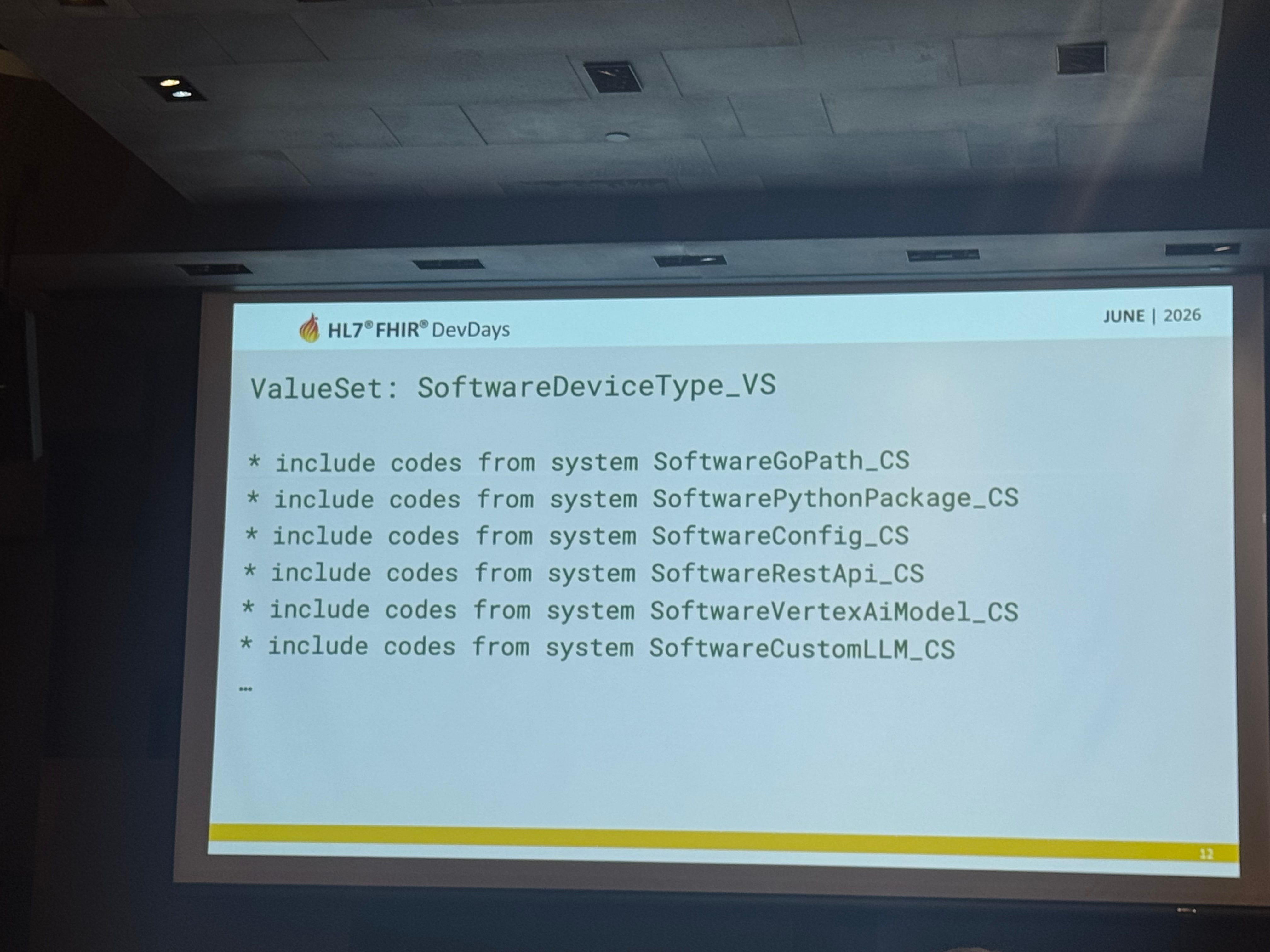
Bryn Rhodes’ “Using Value Set Packages to Keep Implementation Terminology Current” (Smile Digital Health) tackled the genuinely hard problem of keeping terminology fresh in real implementations — value sets drift, and keeping them current is a maintenance nightmare that this work directly addresses.
Elizabeth Amato’s “Generating FHIR Provenance — Challenges and Solutions” (Verily) hit close to home for me, since provenance is central to how I think about agent accountability. Knowing who (or what) did something, and being able to prove it, is one of the unsolved problems in agentic healthcare. Elizabeth’s work on the challenges of actually generating Provenance resources is exactly the kind of thing we need more of.
Kill the Clipboard: the heart of the conference
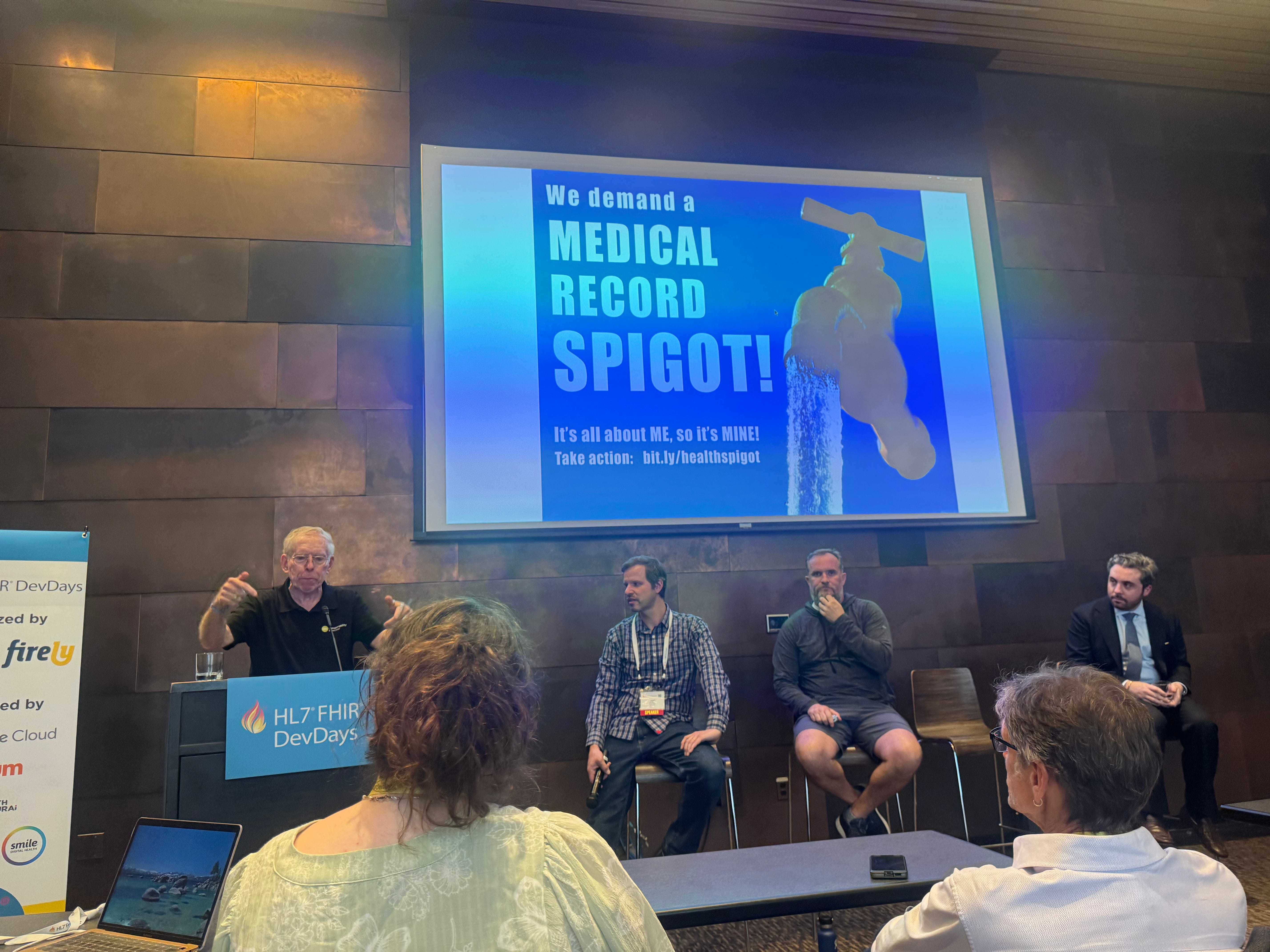
The most moving session, by a distance, was “Kill the Clipboard” with Josh Mandel (Microsoft), Anthony Polizzi (CMS), Dave deBronkart (e-Patient Dave), and James Cummings (Participatory Health).
This is where DevDays showed its soul. e-Patient Dave told the story of his 15-year fight to get access to all of his own patient data a fight that predates FHIR itself. James Cummings shared his family’s deeply personal and inspiring battle, the kind of story that reminds you why any of this matters in the first place. Josh Mandel laid out how SMART Health Links can be the mechanism that lets patients actually share their data on their own terms. And Anthony Polizzi described how CMS is structuring its initiatives to drive progress across the whole ecosystem.
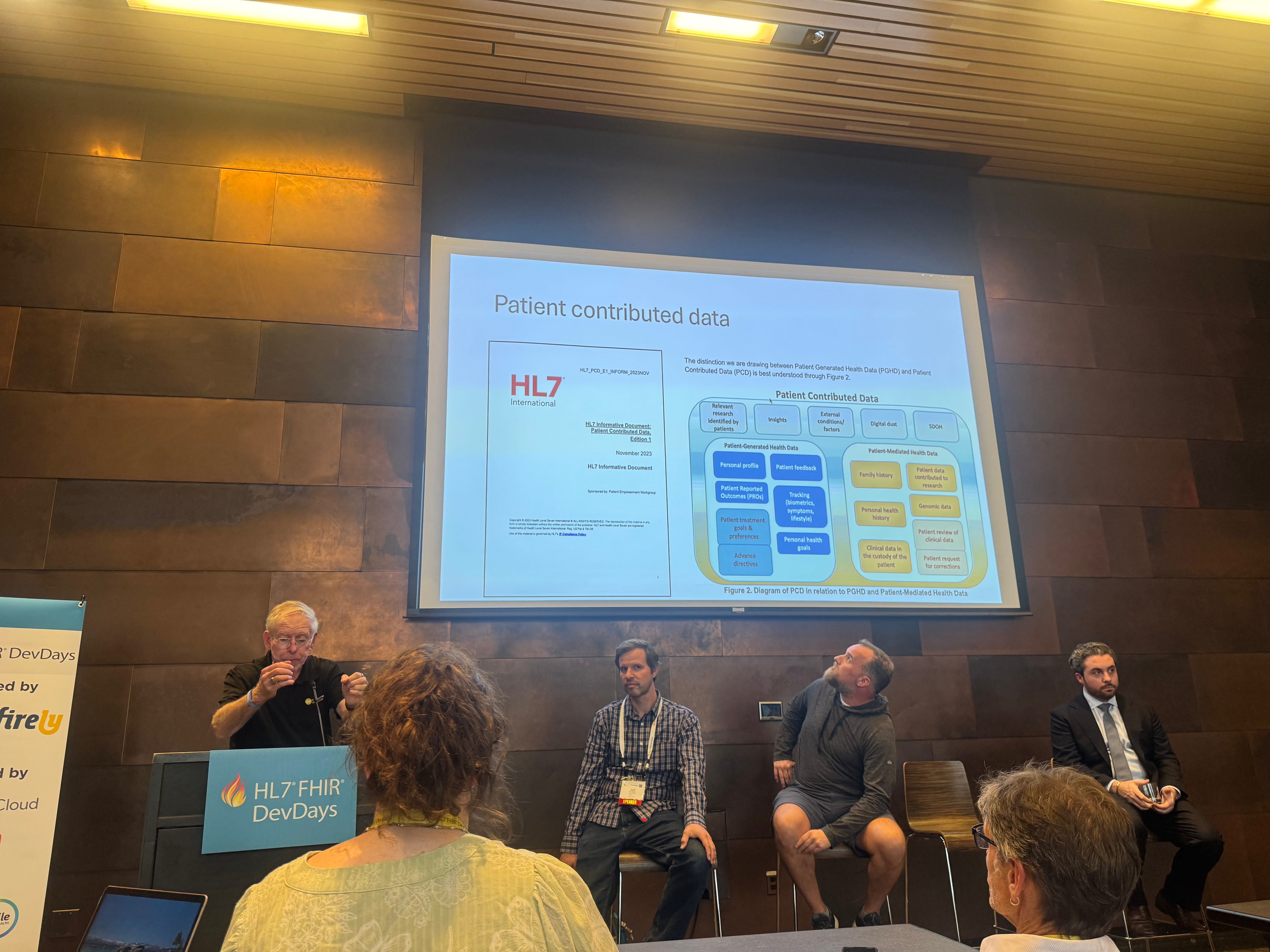
Patient empowerment isn’t an abstraction to these people. It’s a fight they’ve been living for years. Sitting in that room, listening to the human stakes underneath all the technical work the rest of us do, was the highlight of the conference.
My talk: OpenClaw for Healthcare
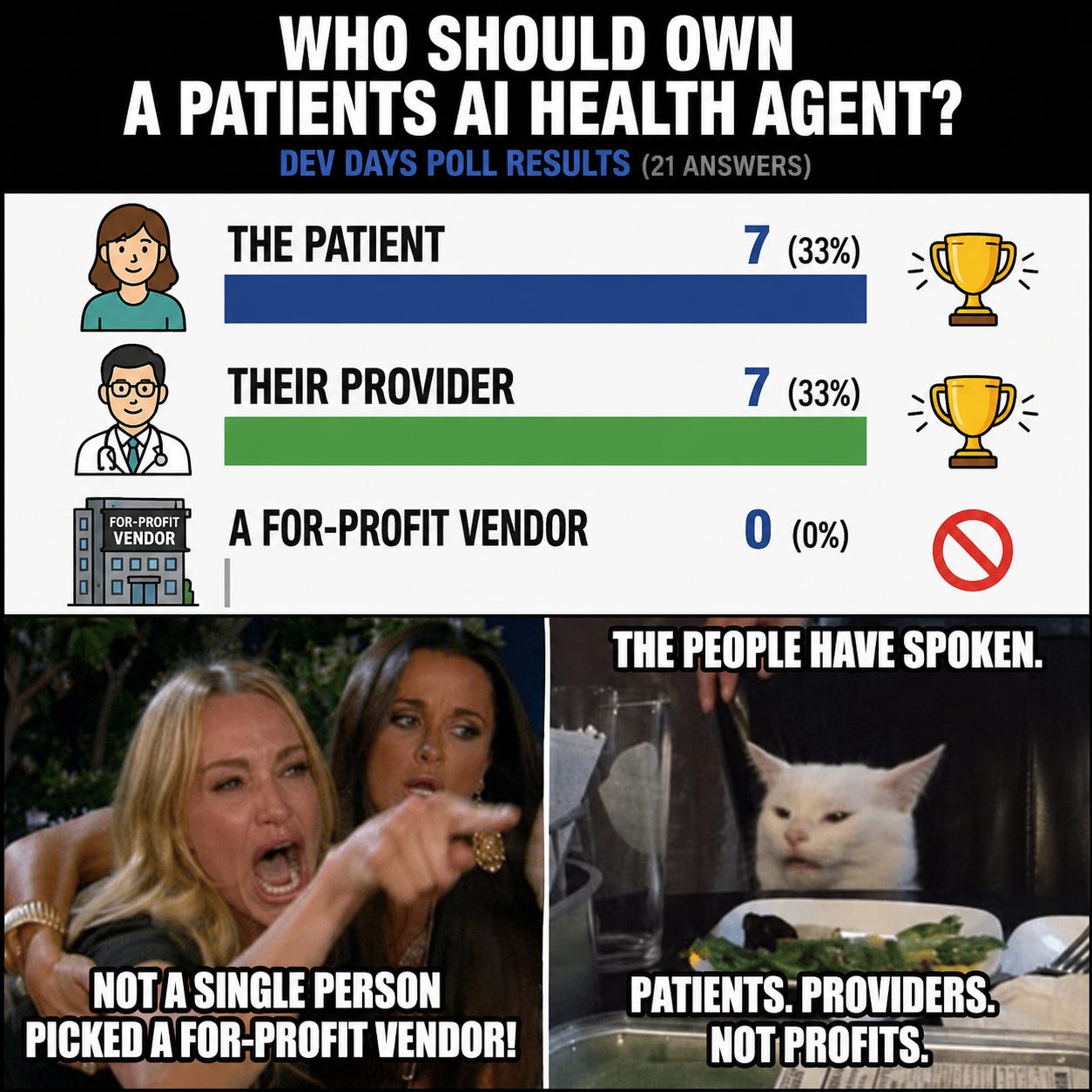
I gave a talk called “OpenClaw for Healthcare: Guardrails, Trust, and Patient Empowerment,” where I let an AI agent loose on my own real health records, live on stage. I want to be clear about why I shared it the way I did: healthclaw.io is an open-source framework for healthcare skills, for OpenClaw and other agentic frameworks, and it isn’t attached to anything I’m selling. That matters to me. This is a patient-empowerment story, not a product funnel. I opened by asking the room who should own a patient’s AI health agent 21 people answered, the patient and their provider tied at the top, and not a single person picked a for-profit vendor. That’s the room describing the architecture I came to demo, so I showed them: an agent connecting across five disconnected systems, cleaning up the data, filling a 40-page intake form, and booking an appointment — with PHI redacted before the model ever saw it, every action audited, and nothing written to the record without a human saying yes. I also showed exactly where it’s still rough, because a demo that hides its seams isn’t useful to anyone trying to build the real thing. That honesty is the DevDays way, and the room rewarded it.
Patient-generated and lifestyle data
“Making Menstrual Cycle Data Interoperable” with Chris Curry (Oura) and Martine Berden showed amazing progress on a category of data that’s historically been siloed and underserved. Getting wearable and lifestyle data into interoperable FHIR is one of the more meaningful frontiers, and it was great to see Oura and the community pushing on it together.
The Nerd Contest: where losing is the best part
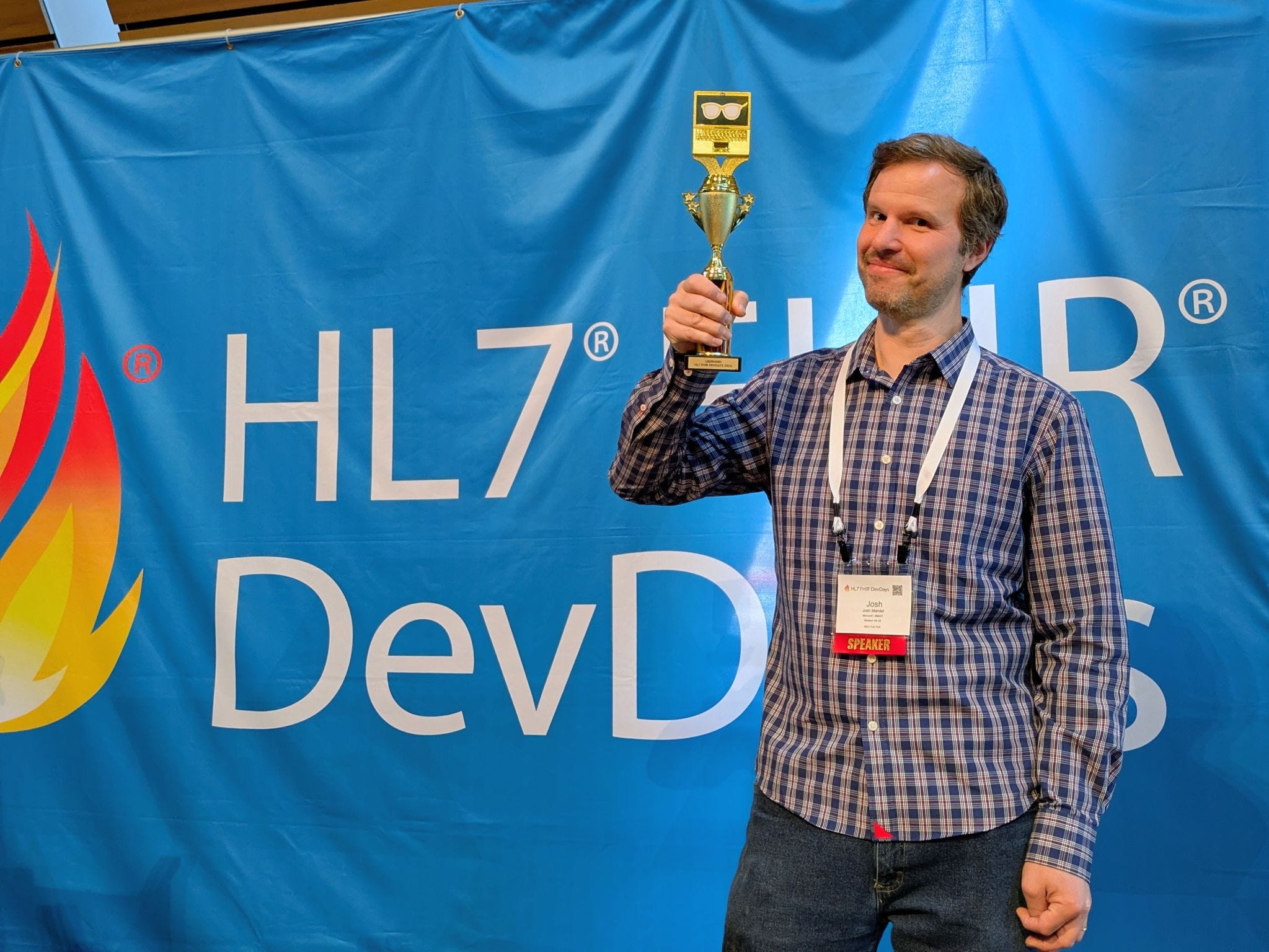
I’d be doing DevDays a disservice if I didn’t mention the Nerd Contest the tradition where attendees submit their most gloriously impractical side projects and the room votes. This is the conference at its most honest: a bunch of builders showing off the things they made purely because they couldn’t not make them.
I submitted ShirtGPT, my t-shirt generator a fully autonomous apparel company that designs and “sells” shirts with zero human input. It has, to date, sold exactly zero t-shirts. I’m very proud of this.
And I lost fair and square to Josh Mandel, who rebuilt and rearchitected the firmware on a baby monitor, hacking it back into something better than the manufacturer shipped. The man wins a Kill the Clipboard panel and the Nerd Contest in the same week. A true nerd in the highest sense of the word. The glasses-on-a-laptop trophy went to the right person.
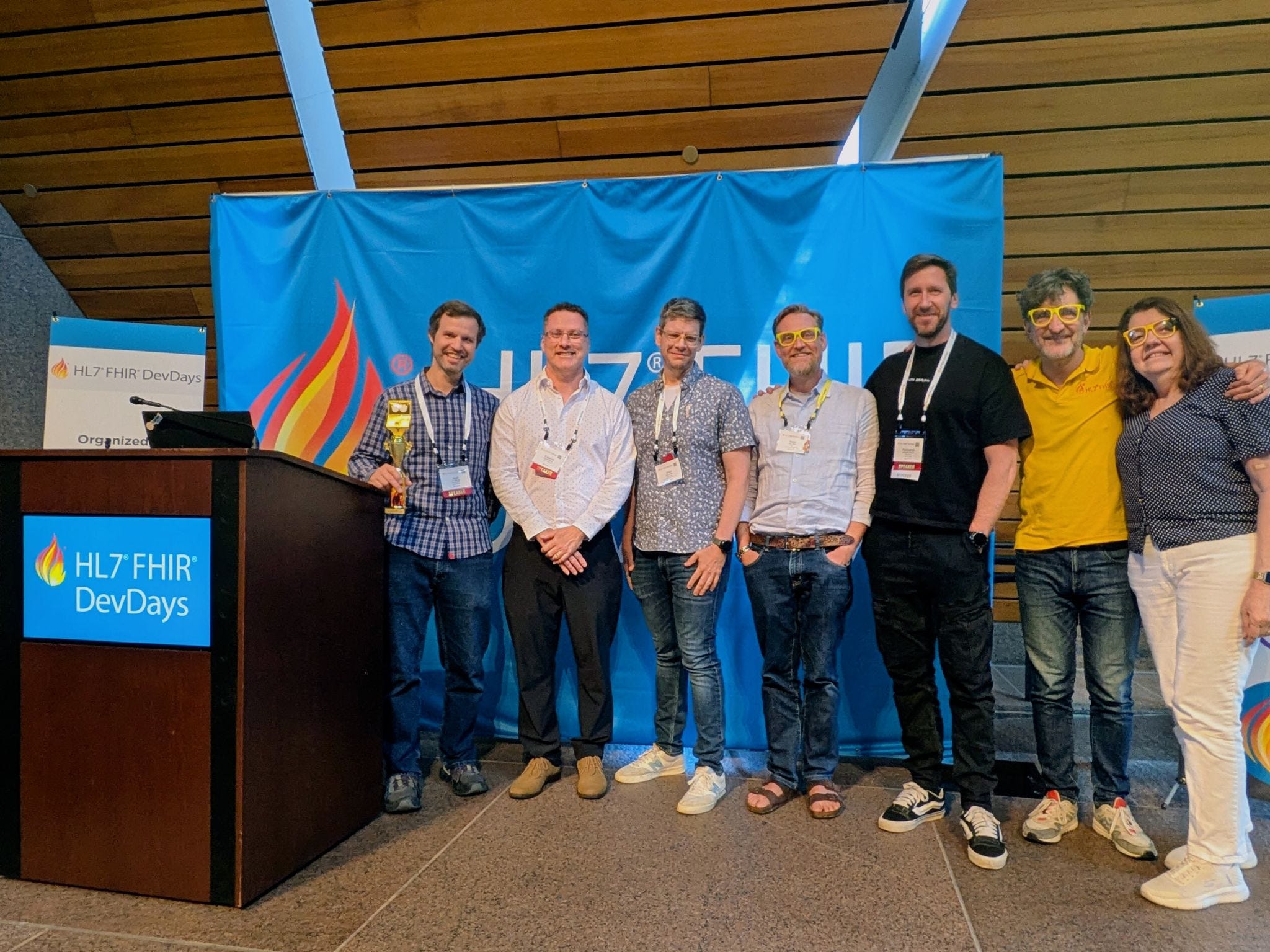
That’s the spirit of this place. Nobody’s monetizing their nerd project. We just like building things, and we like showing each other what we built.
The thing about DevDays
What you can’t capture in a list of talks is the connective tissue between them. The hallway conversations. The “wait, you’re working on that too?” moments. The collaborations that start over coffee and turn into a shared proof of concept three months later. Preston and I started talking about CQL-to-SQL exactly that way. So did half the partnerships in this community.
Everyone here is here because they want to build, learn, and connect not because they have a quota. That’s rare, and it’s worth protecting.
I’ll be catching up on the talks I missed when the recordings post publicly in about six months (attendees get them right away one more reason to come in person). The full scope of the program is genuinely something for everyone: you can browse it here → https://www.devdays.com/wp-content/uploads/2026/06/Printversie_2026_v2.pdf
If you build in healthcare and you’ve never been, come next year. It’s the one where nobody’s selling you anything.


How do I get invited to those conferences where no one is selling me anything, and everyone is building and exchanging ideas? 😉 Thank you for the brilliant overview, Gene Vestel. 👏